You’re scrolling through TikTok comments. Someone writes: “Bro is a total NPC.” Everyone laughs. You don’t.
The word looks familiar. Maybe you’ve seen it in video games. But here? In a comment about a real person? That doesn’t make sense.
You’re not alone. NPC jumped from gaming into everyday slang fast. Now it’s everywhere — comments, group chats, memes, even real conversations.
People use it to describe coworkers. Friends. Strangers on the street. Sometimes it’s playful. Sometimes it stings.
The term carries more weight than it looks like. Calling someone an NPC says something specific about them. It’s not just random internet noise.
This shift happened around 2018 and exploded after 2020. Now in 2025, NPC is part of how Gen Z talks about people who seem… off. Robotic. Predictable. Like they’re running on a script.
If someone hit you with this term, you probably want to know what they really meant. Understanding NPC helps you decode a huge chunk of internet culture. It also helps you know when you’re being roasted.
What Does NPC Mean?
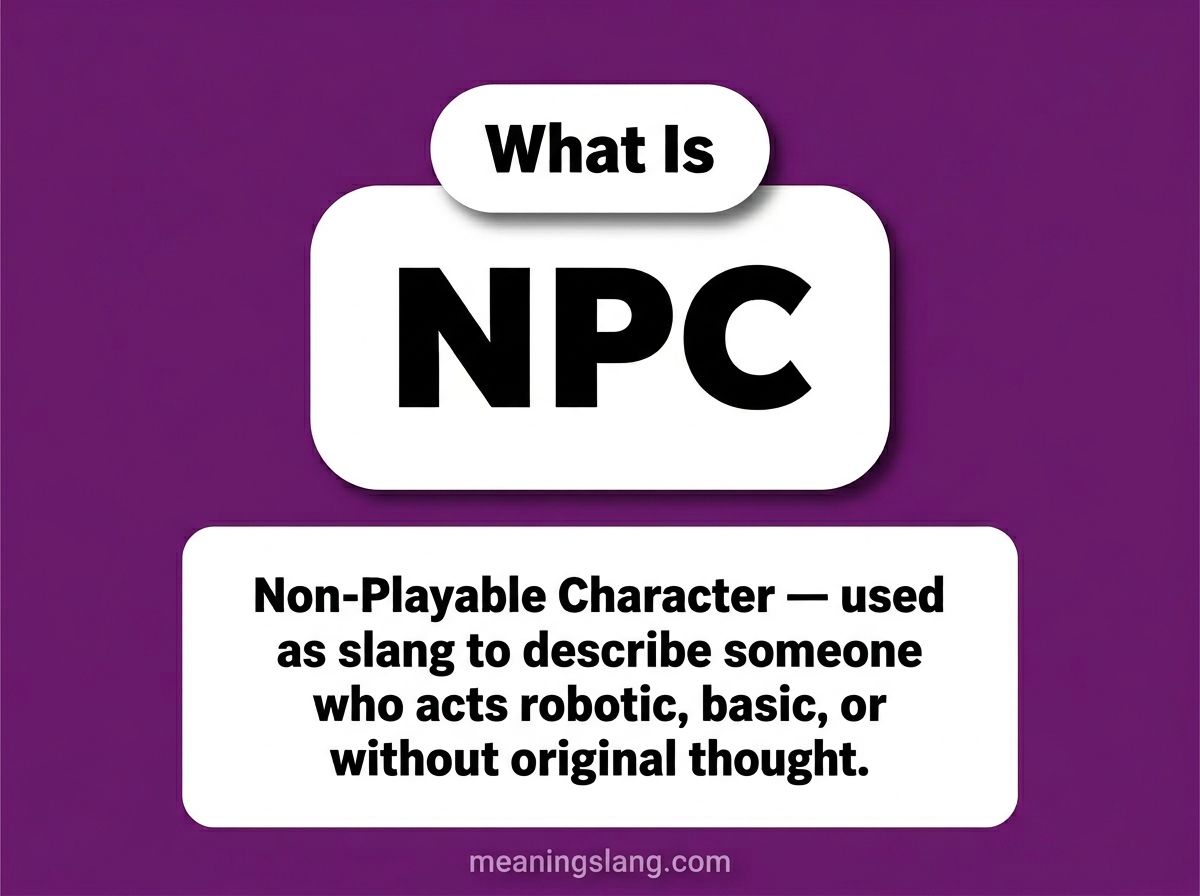
QUICK ANSWER: NPC stands for “non-playable character.” In slang, it means someone who seems boring, predictable, or like they can’t think for themselves. It’s basically calling someone a background character in life.
The term comes straight from video games. In games, NPCs are characters controlled by the computer. They repeat the same lines. They follow the same paths. They exist to fill space.
When you call a real person an NPC, you’re saying they act the same way. They don’t have original thoughts. They just follow trends. They say what everyone else says. They blend into the background like they’re programmed.
The emotional tone depends on context. Sometimes it’s a light joke between friends. “You ordered the same coffee again? Total NPC behavior.” That’s playful.
Other times it’s harsh. Calling someone an NPC can mean you think they’re mindless. They just follow the crowd. They don’t question anything. This version is definitely an insult.
Who says it matters too. Friends teasing each other? No big deal. A stranger in your comments? That’s meant to hurt.
The term is similar to calling someone basic, but sharper. It questions whether the person even has real thoughts. That’s why it hits different than other insults — SMH might show disappointment, but NPC questions your whole personality.
[DEFINITION GRAPHIC HERE — term on left, arrow, plain definition on right, white card background]
Origin and History of “NPC”
NPC started in video games decades ago. The term described any character you couldn’t control. Shop owners. Quest givers. Random villagers walking around.
These characters had limited dialogue. Talk to them twice, you’d hear the same thing. They felt mechanical. Because they were.
The jump to slang happened around 2016-2018. People on forums like 4chan started using NPC to describe people they disagreed with. The idea was political at first — accusing others of not thinking for themselves.
Then came the “NPC Wojak” meme in 2018. It showed a gray, expressionless face. No inner thoughts. Just a blank reaction. This image spread everywhere. It made NPC a mainstream insult.
By 2020, the term lost most of its political edge. It became general slang for anyone seeming robotic or unoriginal. TikTok pushed it further with videos about “NPC energy” and “main character syndrome” — its opposite.
The meaning has softened over time. Now it’s often just playful. But the core idea stayed: an NPC is someone who blends in instead of standing out.
How “NPC” Is Used on Different Platforms
TikTok
NPC lives on TikTok. Creators make videos about “NPC moments” — times they caught themselves acting basic. Others film strangers doing repetitive things. “NPC behavior” became its own content genre.
“POV: You realize you’ve been an NPC your whole life”
On Instagram, NPC shows up in captions and DMs. People joke about their daily routines. They’ll post coffee shop photos with “NPC behavior activated.” Stories sometimes call out friends acting predictable.
“Me ordering the same thing every time… I’m such an NPC”
Twitter/X
Twitter uses NPC more critically. People call out takes they find unoriginal. “This is such an NPC opinion” means the person is just repeating what everyone else says. The tone here is sharper.
“Bro really tweeted the most NPC response possible”
Snapchat
Snaps about NPC usually involve friends. You might send someone a pic of themselves doing something boring. Caption it “NPC caught on camera.” It’s usually affectionate teasing.
“Caught you in NPC mode lol”
Discord/Gaming
This is where NPC feels most natural. Gamers use it constantly. They’ll call teammates NPCs for making dumb moves. Or describe their own gameplay as “NPC energy” when they’re not paying attention.
“I played like an NPC that whole round”
Reddit threads discuss NPC behavior seriously. People analyze what makes someone seem like an NPC. Others share stories of meeting “real-life NPCs” — people who felt weirdly robotic.
“Met a guy who only talks about weather. Total NPC.”
| Platform | Common Use | Tone | Example |
|---|---|---|---|
| TikTok | Videos about NPC moments | Playful, self-aware | “My NPC morning routine” |
| Captions, DM jokes | Light, teasing | “NPC behavior fr” | |
| Twitter/X | Calling out opinions | Sharp, critical | “Most NPC take I’ve seen” |
| Snapchat | Friend roasts | Affectionate | “You look like an NPC rn” |
| Discord | Gaming callouts | Casual, common | “Playing like a total NPC” |
| Discussions, stories | Analytical | “What makes someone an NPC?” |
NPC in Texting vs. Real Life
In texts, NPC flows naturally. You type it fast. Everyone gets it. No explanation needed.
Saying “NPC” out loud works too. It’s said like three letters: “en-pee-see.” People do say it in real conversations, especially Gen Z.
But the tone shifts when spoken. In text, you can be vague. Out loud, calling someone an NPC feels more direct. More personal. It’s harder to hide behind irony.
Written NPC might get a laugh. Spoken NPC might start something. Know your audience. With close friends, it’s whatever. With acquaintances, be careful.
Examples of “NPC” in Sentences
GROUP 1 — Friendly/Casual
“I just walked into a room and forgot why. Total NPC moment.”
“You’ve eaten the same lunch for three weeks straight. NPC behavior.”
“I stood in front of the fridge for five minutes doing nothing. I’m literally an NPC.”
GROUP 2 — Sarcastic/Humorous
“Oh you think pineapple on pizza is bad? What an NPC take.”
“He said ‘it is what it is’ and I knew he was an NPC.”
GROUP 3 — More Critical
“Everyone in that meeting just agreed with the boss. Room full of NPCs.”
“Imagine having the same opinion as everyone else. NPC energy.”
GROUP 4 — Online/Caption Use
“Me pretending to work while my brain runs on NPC mode”
“POV: you’re the main character and everyone else is an NPC”
“NPC behavior but make it aesthetic ✨”
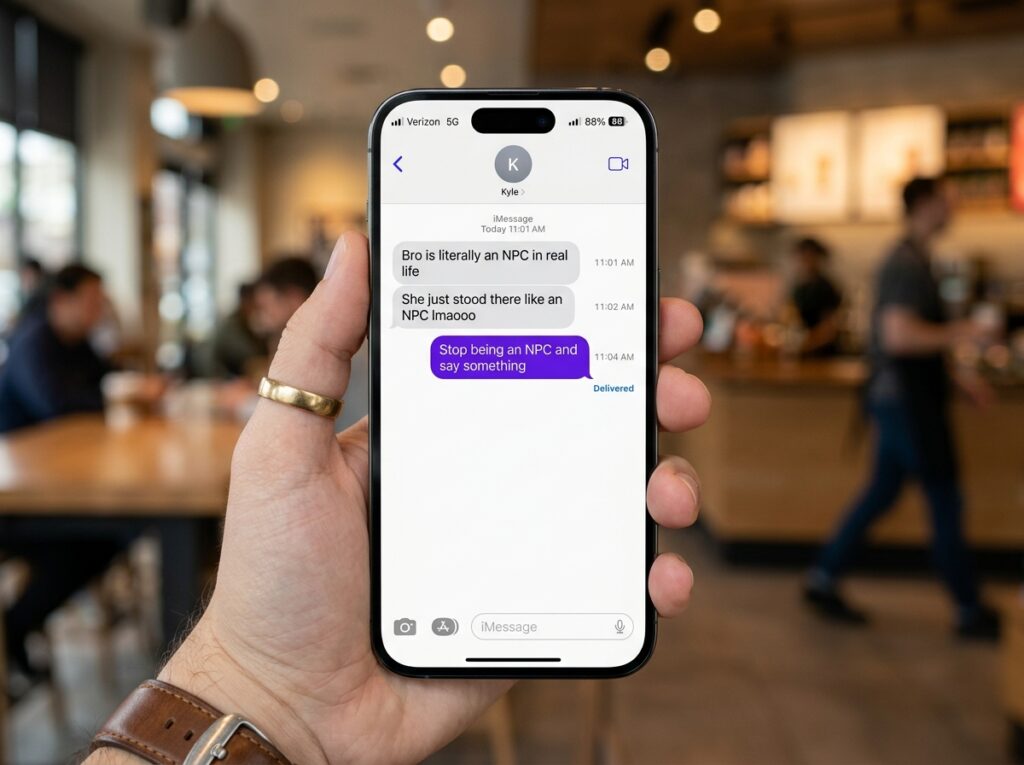
[EXAMPLE CHAT SCREENSHOT MOCKUP — fake phone chat bubbles, iMessage or WhatsApp style]
Variations and Related Slang
NPC doesn’t have many spelling variations. You’ll see it as:
- NPC (standard)
- npc (lowercase)
- N.P.C. (rare, older)
Some people write “NPC energy” or “NPC behavior” as complete phrases. “NPC moment” describes a specific incident.
Related slang captures similar ideas. The term connects to a whole vocabulary about authenticity. If you’ve heard someone called based, that’s almost the opposite of NPC — it means they think for themselves.
Sheep is an older term with the same idea. It means someone who follows the crowd blindly.
Basic overlaps with NPC. Both suggest someone is unoriginal. But NPC goes further — it questions their whole personality.
Main character is the opposite. Someone with main character energy stands out. They see themselves as the star. NPCs are background extras.
Drone sometimes substitutes for NPC. Same meaning — someone mechanical and boring.
| Term | Meaning | Similar/Different? |
|---|---|---|
| NPC | Someone robotic or unoriginal | — |
| Basic | Predictable, follows trends | Similar but softer |
| Sheep | Blindly follows others | Similar, older term |
| Main character | Someone who stands out | Opposite meaning |
| Drone | Robotic, mindless | Very similar |
Is “NPC” Safe for Kids?
Short answer: Mostly yes, but it can be hurtful.
NPC has no bad words in it. No sexual meaning. No violence. In that sense, it’s fine for kids to know.
But NPC is often an insult. Calling someone an NPC says they’re boring, brainless, or fake. That can hurt feelings. Kids might use it to bully classmates who don’t fit in.
The term shows up in gaming spaces constantly. If your kid plays video games, they’ve probably heard it. They might already use it.
Watch for how they use it. Joking about their own NPC moments? Harmless. Calling other kids NPCs to exclude them? That’s a problem.
Teachers probably won’t flag NPC unless it’s used to mock someone. It flies under the radar more than obvious insults. But the impact can still sting.
Talk to kids about how words affect others. NPC seems harmless because it’s from games. But telling someone they have no real personality isn’t kind.
[PARENT SAFETY ICON — shield/safety graphic, 300x200px, “Parent Guide” label]
When to Use (and Avoid) “NPC”
USE IT WHEN:
- You’re joking about your own boring moments
- Close friends will get the reference
- The tone is clearly playful
- You’re commenting on fictional characters or memes
AVOID IT WHEN:
- You’re talking to someone who might not get it
- The person could take real offense
- You’re in professional settings
- You’re using it to genuinely dismiss someone’s thoughts
- You don’t know the person well
Conclusion
NPC means calling someone a background character — predictable, unoriginal, running on autopilot. It jumped from video games into everyday slang and stuck.
The term shows how much Gen Z values authenticity. Standing out matters. Having your own opinions matters. Nobody wants to be the forgettable character in someone else’s story.
Language like this helps people name something they’ve always noticed. Some people just seem… scripted. Now there’s a word for that feeling.
Use NPC carefully. It’s fun between friends but cutting toward strangers. Know the difference between teasing and dismissing someone entirely.
Slang like NPC, sigma, and main character all point to the same question: Who are you, really? That’s worth thinking about.
FAQ
What does NPC mean when someone calls you that?
They’re saying you seem boring, predictable, or like you can’t think for yourself. It compares you to a video game character that just runs on a script. It’s usually an insult, though sometimes friends use it as a light joke.
Is being called an NPC a bad thing?
Usually, yes. NPC implies you lack originality or independent thought. However, context matters. Friends teasing each other about “NPC moments” is harmless. A stranger calling you an NPC online is trying to insult you.
Where did NPC slang come from?
It started in video games where NPC means “non-playable character.” Around 2016-2018, internet forums began using it to describe real people. The 2018 NPC Wojak meme made it mainstream slang across all platforms.
What’s the opposite of an NPC?
The opposite is having “main character energy.” This means you stand out, make bold choices, and live like you’re the star of your own story. Being based also suggests independence and originality.
Do people say NPC out loud or just type it?
Both. People say “en-pee-see” in real conversations, especially Gen Z. It works in speech but hits harder when spoken directly to someone. In texts and comments, the tone is often lighter and easier to brush off.