Someone just replied to your comment with “IMO, that take is wrong.” You stare at those three letters. Is this an insult? An organization? Some app you’ve never heard of?
You’re not alone. IMO pops up everywhere now. Group chats. Reddit threads. Work emails. TikTok comments. Even your mom might use it. But nobody ever explains what it actually means.
Here’s the thing: IMO is one of the oldest internet acronyms still in heavy rotation. It survived AIM, MySpace, and countless dead social networks. And unlike slang that fades after a few months, this one stuck around because it’s genuinely useful.
People use IMO to soften opinions, avoid arguments, and sound less aggressive online. It works like saying “no offense” but shorter and less annoying. Similar to how NGL softens honesty, IMO makes hot takes feel more casual.
By the end of this breakdown, you’ll know exactly when to drop an IMO and when to skip it entirely.
What Does IMO Mean
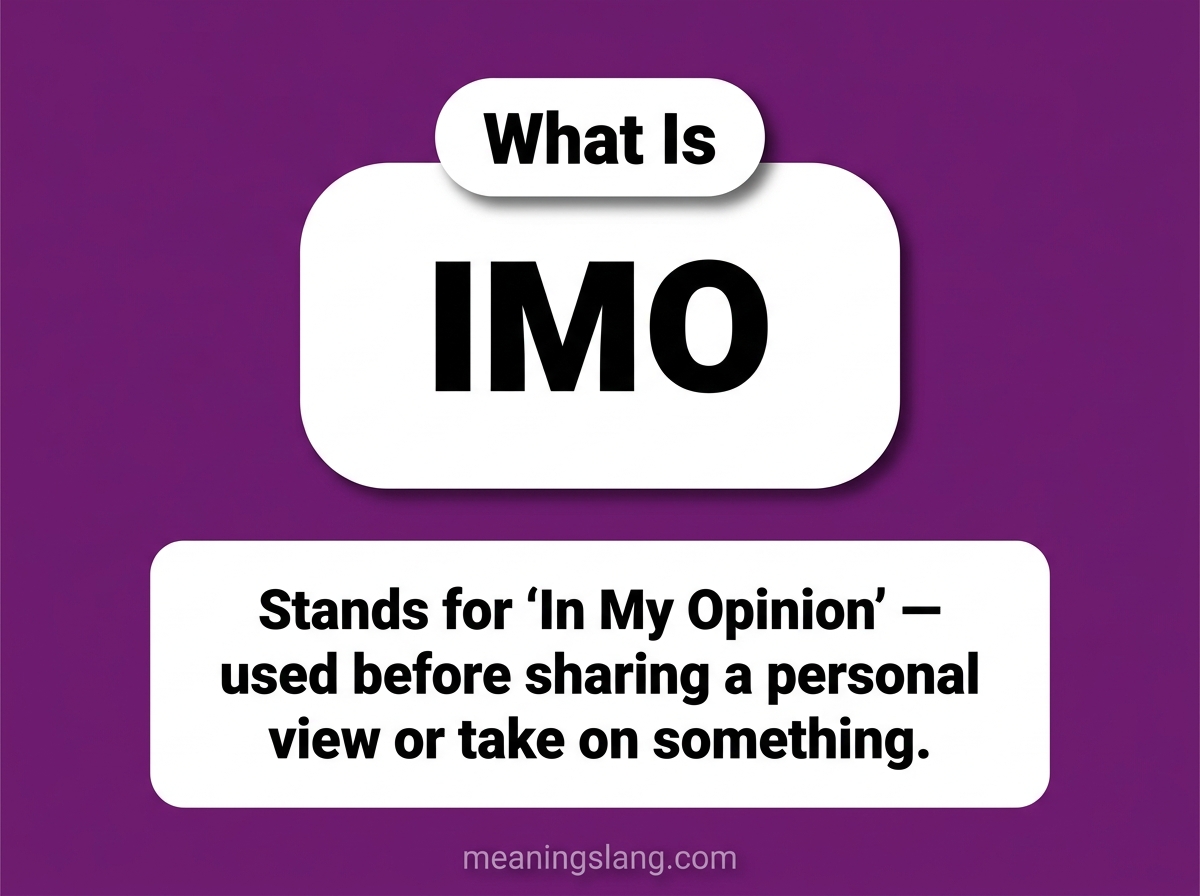
QUICK ANSWER: IMO stands for “In My Opinion.” It signals that what you’re about to say is personal, not fact. It’s a quick way to share your thoughts without sounding too aggressive.
IMO is pure shorthand. When someone types “IMO, pineapple on pizza slaps,” they’re saying this is their personal take. They’re not claiming it’s universal truth. Just their view.
The emotional tone is usually casual and non-confrontational. Think of it as a verbal shrug. You’re offering your perspective while acknowledging others might disagree. “IMO, that movie was mid” hits softer than “that movie was mid.”
Context matters though. In a heated debate, IMO can feel dismissive. Like someone’s trying to end discussion. “IMO, you’re wrong” isn’t actually polite just because you added the acronym.
You’ll see variations in how strongly people use it. Some folks type IMO before every opinion. Others save it for controversial takes. The meaning stays the same either way: this is just what I think.
It works in texts, tweets, emails, and comments. Almost anywhere you’d type an opinion, IMO fits.
[DEFINITION GRAPHIC HERE — term on left, arrow, plain definition on right, white card background]
Origin and History of “IMO”
IMO wasn’t born on TikTok or even Twitter. It goes back to the early internet days of the 1980s and 1990s.
Usenet forums and early chat rooms created the need for quick typing. People discussed everything from Star Trek to politics. Character limits and slow connections made abbreviations essential. IMO emerged as one of the first opinion-markers online.
By the time AOL Instant Messenger blew up in the late 1990s, IMO was already standard. Teens and young adults used it constantly. It spread through email chains, message boards, and early blogs.
The acronym survived every platform shift. MySpace used it. Facebook adopted it. Twitter made it even more popular with character limits. Now Gen Z uses it on TikTok without knowing it’s older than most of them.
Unlike trendy slang that dies quickly, IMO stuck because it fills a real communication gap. There’s no shorter way to say “this is just my opinion.” That utility kept it alive for over three decades.
How “IMO” Is Used on Different Platforms
TikTok
Comments sections on TikTok run hot. IMO helps creators and viewers share opinions without starting wars. You’ll see it on controversial takes about music, fashion, and drama. “IMO, this trend is already over.”
On Instagram, IMO shows up in DMs and comment sections. Stories with question stickers often get IMO responses. Captions sometimes use it too. “New haircut vibes. IMO, this is my best era.”
Twitter/X
Quote tweets and replies love IMO. The platform’s debate culture makes opinion-markers essential. People use it to separate facts from takes. Much like SMH expresses disappointment, IMO signals personal judgment.
Snapchat
Quick snaps between friends include IMO for casual opinions. “IMO we should hit that party tonight.” It’s conversational and low-pressure here.
Discord/Gaming Chats
Gamers use IMO constantly. Build recommendations, tier lists, and strategy discussions all benefit from it. “IMO, that character is broken.”
Reddit practically runs on IMO. Every subreddit has users clarifying their opinions versus facts. Unpopular opinion threads especially see heavy IMO usage.
| Platform | Common Use | Tone | Example |
|---|---|---|---|
| TikTok | Comments on trends | Casual/debatable | “IMO, this song is overplayed” |
| DMs and captions | Friendly | “IMO, you looked better with bangs” | |
| Twitter/X | Quote tweets, replies | Direct | “IMO, that take is trash” |
| Snapchat | Quick messages | Playful | “IMO we need food rn” |
| Discord | Gaming discussions | Informative | “IMO, use the shield build” |
| Comments, debates | Analytical | “IMO, the sequel was better” |
IMO in Texting vs. Real Life
In texting, IMO flows naturally. Three quick letters. No explanation needed. Most people between 15 and 45 recognize it instantly.
But does anyone say “IMO” out loud? Rarely. In real conversation, people just say “in my opinion” or “I think.” Pronouncing each letter sounds robotic. “Eye-em-oh” doesn’t roll off the tongue.
Some younger people might say it ironically. Like mocking internet speech. “IMO, literally speaking here, that’s fire.” But it’s clearly a joke.
The meaning doesn’t shift when spoken. It just sounds weird. Stick to typing it. Your actual voice handles “I think” perfectly fine.
Examples of “IMO” in Sentences
GROUP 1 — Friendly/Casual
“IMO, that restaurant is way overrated.”
“We should leave early IMO, traffic’s gonna be brutal.”
“IMO, your new apartment looks amazing.”
GROUP 2 — Romantic/Flirty
“IMO, you’re the cutest person here.”
“That dress on you? Perfect IMO.”
GROUP 3 — Sarcastic/Humorous
“IMO, sleeping until noon is peak self-care.”
“That was a great idea. IMO. Obviously. Not sarcasm at all.”
GROUP 4 — Online/Caption Use
“IMO, this album deserved more hype.”
“Best pizza in the city IMO. Fight me.”
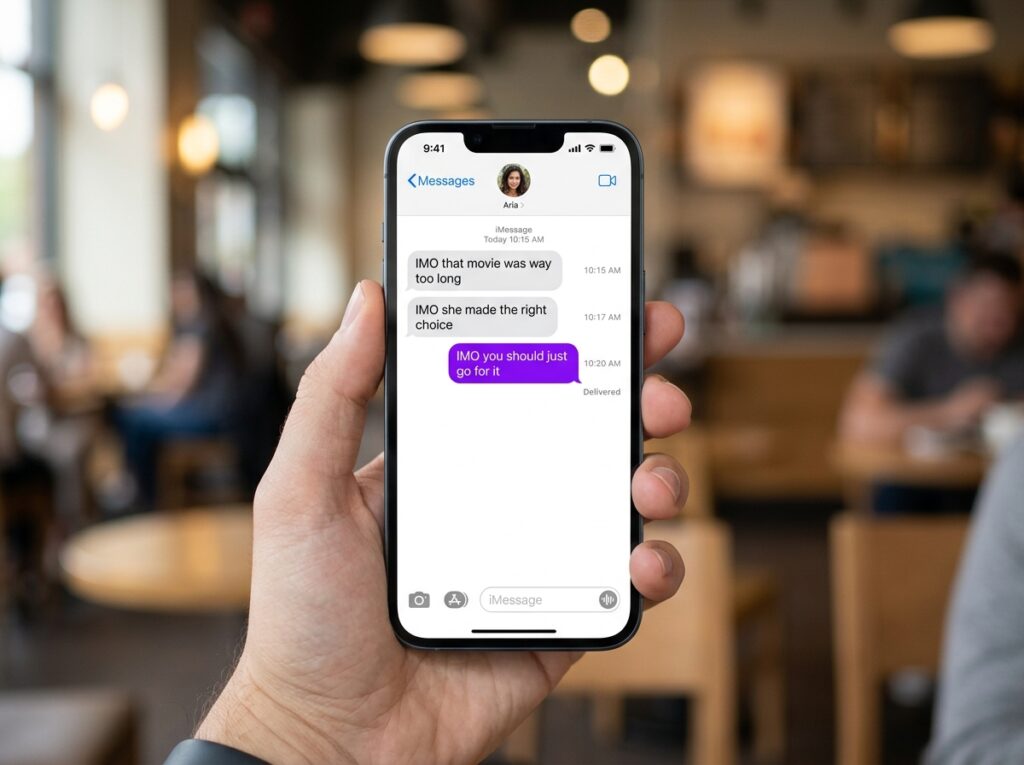
[EXAMPLE CHAT SCREENSHOT MOCKUP — fake phone chat bubbles, iMessage or WhatsApp style]
Variations and Related Slang
The main variation is IMHO — “In My Humble Opinion.” It adds fake humility. Some people use it sincerely. Others use it sarcastically before a bold take. “IMHO, I’m the best at this game.”
You might also see IMO written lowercase as “imo.” Same meaning. Just lazier typing.
Related acronyms serve similar purposes. IIRC means “If I Recall Correctly” and softens claims about memory. AFAIK stands for “As Far As I Know.” These all hedge statements to sound less absolute.
Other opinion-related slang includes NGL (Not Gonna Lie) and ISTG (I Swear To God). Each adds a different flavor to opinions.
| Term | Meaning | Similar/Different? |
|---|---|---|
| IMO | In My Opinion | — |
| IMHO | In My Humble Opinion | More formal or sarcastic version |
| NGL | Not Gonna Lie | Adds honesty emphasis |
| AFAIK | As Far As I Know | Hedges knowledge claims |
| IIRC | If I Recall Correctly | Hedges memory claims |
Is “IMO” Safe for Kids?
Yes, IMO is completely safe for kids. There’s nothing offensive, sexual, or aggressive about the phrase itself.
It simply means “in my opinion.” Kids use it to share thoughts about games, shows, and school topics. Teachers wouldn’t flag this in a paper or message.
The only potential issue is context. A kid could use IMO before something rude. “IMO, you’re annoying” is still rude. The acronym doesn’t change the message’s impact.
For parents: if you see your kid typing IMO, there’s no concern about the acronym itself. Check what opinion they’re sharing. That matters more than the three letters before it.
Schools generally view IMO as standard internet shorthand. It’s no different from typing “btw” or “lol.” Completely normal communication.
[PARENT SAFETY ICON — shield/safety graphic, 300x200px, “Parent Guide” label]
When to Use (and Avoid) “IMO”
USE IT WHEN:
- Sharing a personal take on something subjective
- Wanting to sound less aggressive in debates
- Commenting on someone’s creative work
- Giving advice without sounding preachy
AVOID IT WHEN:
- Stating actual facts (you don’t need “IMO, water is wet”)
- Writing formal documents or professional emails
- Every single sentence (overuse gets annoying fast)
- Trying to manipulate someone into accepting your view as neutral
Conclusion
IMO means “in my opinion.” It’s a three-decade-old internet shortcut that refuses to die because it actually works.
This tiny acronym does something powerful. It reminds everyone that opinions aren’t facts. In a world where online arguments escalate fast, that small distinction matters. IMO creates space for disagreement without hostility.
Language evolves because we need better tools to connect. Slang like OFC (of course) and IMO prove that shortcuts can add meaning, not just save time. Use IMO when you want your opinion heard but not forced on anyone.
FAQ
What does IMO mean in texting?
IMO means “In My Opinion” in texting. People use it before sharing personal views or thoughts. It signals that the statement is subjective, not a fact. You’ll see it in casual conversations across all messaging apps.
Is IMHO different from IMO?
IMHO adds “humble” to the phrase, making it “In My Humble Opinion.” It can sound more polite or sometimes sarcastic. Both mean basically the same thing. IMHO just adds a layer of mock modesty.
Can I use IMO in professional emails?
Generally, avoid it. Professional communication expects full phrases like “in my opinion.” Some casual workplaces allow it in Slack or Teams. When in doubt, write the words out. It looks more polished.
Why do people use IMO so much online?
Online communication lacks tone of voice. IMO helps clarify that you’re sharing a perspective, not stating facts. It prevents arguments by signaling openness to other views. It’s quick and universally understood.
Is IMO rude to use?
No, IMO itself isn’t rude. It’s actually meant to soften opinions and show respect for other viewpoints. However, what you say after IMO can still be rude. The acronym doesn’t excuse mean comments.