Someone just called your favorite influencer a “POS” in the comments. You scroll past, then stop. Wait. Isn’t POS that thing at checkout counters? The card reader?
Yeah, no. Not here.
When you see POS in a heated comment section or an angry text, it means something completely different. And it’s not nice. This acronym gets thrown around when someone’s genuinely upset. You’ll spot it on Twitter drama threads, TikTok callouts, and group chats that just went sideways.
The confusion is real. POS has lived a double life for years. One version sits in every store you’ve ever shopped at. The other lives in texts where someone just lost their patience.
If you’ve been seeing this pop up more often, you’re not imagining it. People use POS when they’re done being polite. It’s quick, it’s harsh, and it says exactly what someone thinks about a person. Similar to how SMH expresses disappointment, POS takes that frustration several steps further.
Here’s exactly what it means, where it came from, and whether you should ever type it yourself.
What Does POS Mean?
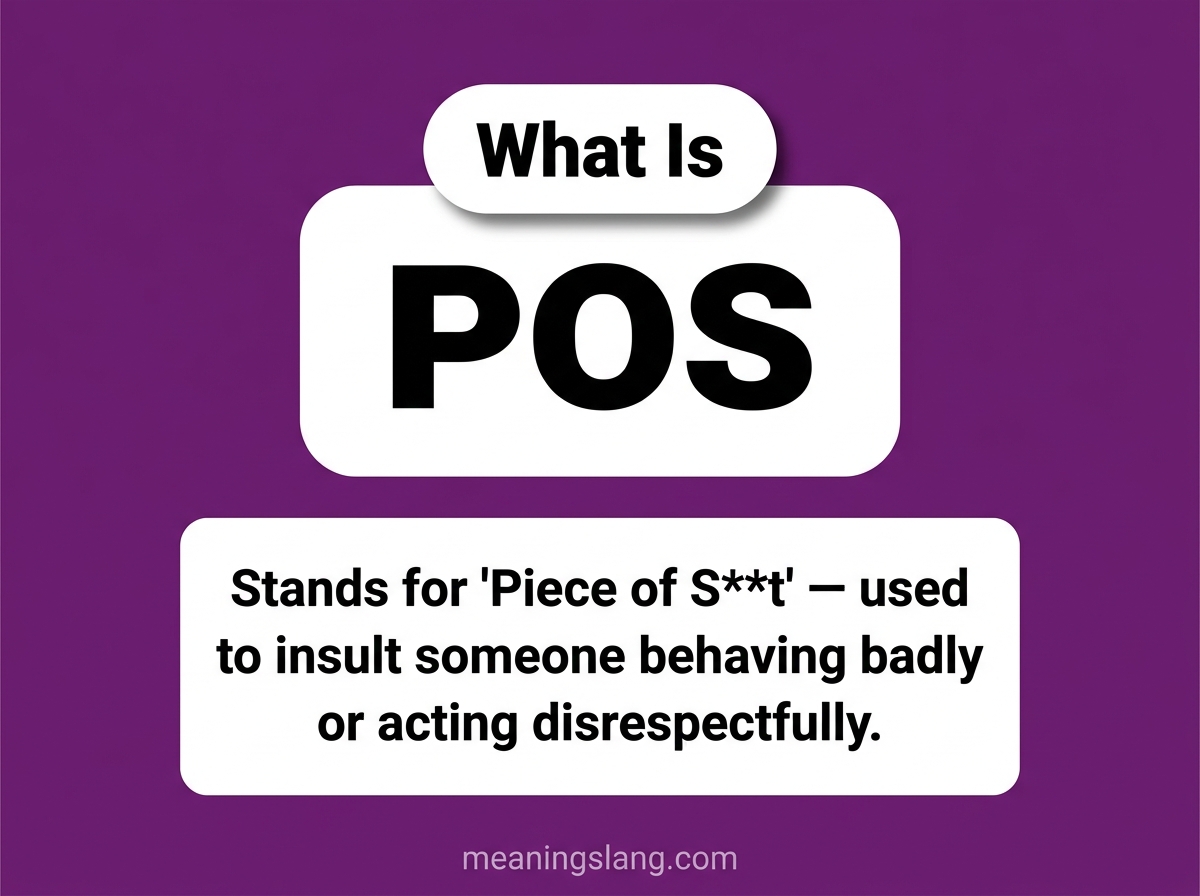
QUICK ANSWER: POS stands for “Piece of S***” in slang. It’s a harsh insult used to call someone a terrible or worthless person. Context matters — in retail, POS means “Point of Sale,” but in texts and online, it’s almost always the insult.
The slang version of POS is not subtle. When someone types this, they’re calling another person garbage. Complete trash. It’s the kind of insult you save for when you’re really angry.
The tone is always negative. There’s no playful way to use this one. Unlike slang that can flip between friendly and aggressive, POS stays mean. You’ll see it when someone feels genuinely wronged or disgusted by another person’s behavior.
“My ex is such a POS” hits different than calling them annoying. It says you think they’re fundamentally bad.
The meaning doesn’t really shift based on who says it. A teen calling their cheating ex a POS means the same thing as an adult calling a corrupt politician one. The target changes, but the venom stays consistent.
You might see it softened sometimes. “Total POS move” focuses on the action, not the whole person. But that’s still harsh. Nobody types POS about someone they respect.
[DEFINITION GRAPHIC HERE — term on left, arrow, plain definition on right, white card background]
Origin and History of “POS”
POS as an insult didn’t start online. The phrase “piece of s***” has been around in spoken English for decades. Military slang used it heavily in the mid-1900s.
The acronym version gained traction in early internet chat rooms. When people needed to type fast and stay under radar, abbreviations helped. POS fit perfectly. Three letters. Maximum impact. Easy to slip past basic content filters.
By the 2000s, POS lived on forums, instant messengers, and early social media. It stayed relatively underground compared to mainstream slang. Most people knew the retail meaning first.
The slang version never had one viral moment. It just spread slowly through online anger. Gaming communities used it for toxic players. Relationship forums used it for terrible exes. It found its audience naturally.
Today, both meanings coexist. Context tells you which one applies. A cashier talks about the POS system. Your friend talks about their POS landlord. Same letters, wildly different energy.
How “POS” Is Used on Different Platforms
TikTok
POS appears in rant videos and storytime content. Creators use it when describing people who wronged them. “And that’s when I realized he was a complete POS.” The comments section echoes it back when viewers agree.
You’ll find it in DMs more than captions. People vent privately to friends about someone. Story replies might include it when reacting to drama. Public captions usually avoid it since the platform feels more polished.
Twitter/X
This is POS territory. Quote tweets calling out bad behavior often include it. “This POS really thought we wouldn’t notice.” The fast, aggressive energy of Twitter matches the insult perfectly.
Snapchat
Private snaps between close friends use it freely. “Look at this POS text he sent me.” It stays in disappearing messages since people feel safer being blunt there.
Discord/Gaming
Gaming chats use POS constantly. Toxic teammates, cheaters, and griefers all earn the title. “Report that POS” shows up after someone ruins a match intentionally.
Subreddits like AITA or relationship advice see it often. “NTA, your coworker is a POS.” Redditors don’t hold back when judging people in stories.
| Platform | Common Use | Tone | Example |
|---|---|---|---|
| TikTok | Storytimes, rants | Angry, venting | “Turns out he was a POS the whole time” |
| DMs, story replies | Private frustration | “Your boss sounds like a total POS” | |
| Twitter/X | Quote tweets, callouts | Aggressive, direct | “This POS blocked me after I called him out” |
| Snapchat | Private venting | Casual anger | “My roommate is such a POS” |
| Discord | Gaming complaints | Hostile | “That POS just threw the game” |
| Judgment comments | Matter-of-fact | “Your ex is a POS, move on” |
POS in Texting vs. Real Life
In texts, POS flows naturally. It’s quick to type. Three letters. Done. People use it without thinking twice in casual conversations with close friends.
Out loud? People usually just say the full phrase. “Piece of s***” sounds more natural spoken. Saying “poss” or spelling out “P-O-S” feels awkward and forced.
The written version lets you stay slightly removed from the profanity. You’re technically not typing the full swear word. But everyone knows what you mean.
Real life reserves this for when you’re genuinely heated. You won’t casually drop it in conversation like “lol” or “bruh.” It carries weight whether typed or spoken.
Examples of “POS” in Sentences
GROUP 1 — Friendly/Casual
- “I can’t believe I dated that POS for two years.”
- “The delivery driver left my package in the rain. What a POS.”
- “My old car was such a POS, it broke down every month.”
GROUP 2 — Sarcastic/Humorous
- “Oh great, my POS printer jammed again. Love that for me.”
- “He ghosted her after three months? Certified POS behavior.”
GROUP 3 — Angry/Venting
- “That POS stole my parking spot while I was waiting.”
- “I hope that POS gets exactly what he deserves.”
- “She’s a POS and everyone finally sees it.”
GROUP 4 — Online/Caption Use
- “When you realize your favorite YouTuber is actually a POS 💀”
- “POV: Finding out your friend’s ex is a POS and keeping your mouth shut”
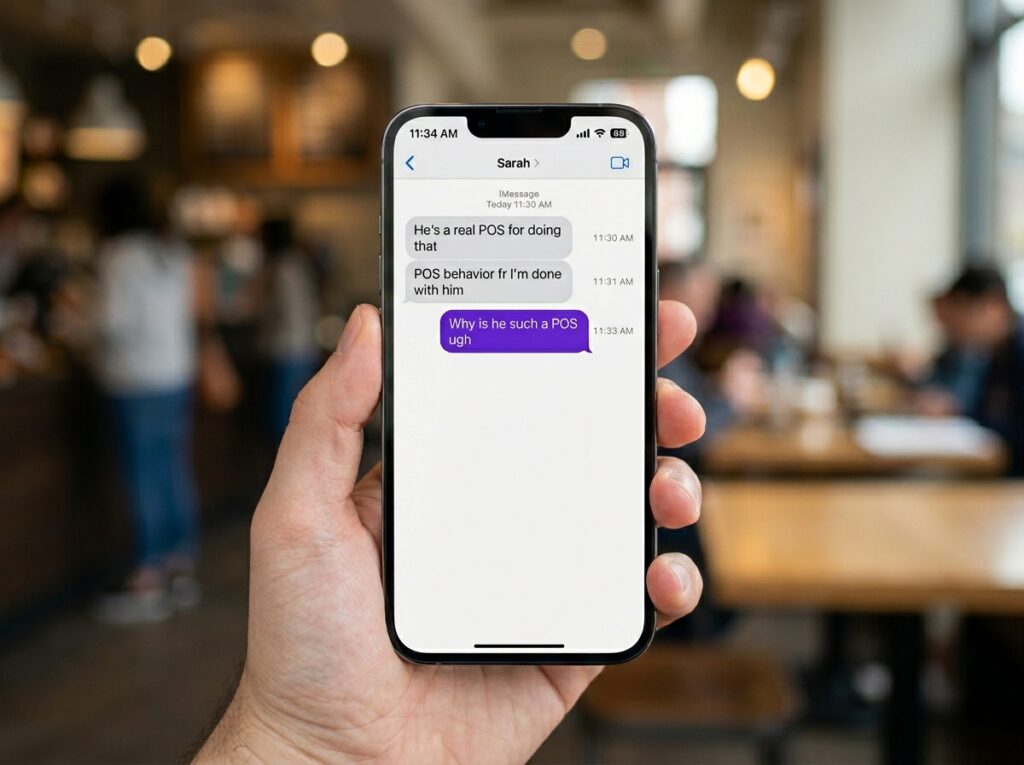
[EXAMPLE CHAT SCREENSHOT MOCKUP — fake phone chat bubbles, iMessage or WhatsApp style]
Variations and Related Slang
POS doesn’t have many spelling variations. You might see it lowercase as “pos” in casual typing. Some people write “P.O.S.” with periods, but that’s less common now.
Related insults carry similar energy. If someone’s calling out bad behavior, they might use trash or garbage as noun insults. NGL often appears before harsh opinions. “NGL he’s a POS” sets up the honesty.
Sus calls out sketchy behavior but stays milder. Calling someone sus means they’re suspicious. Calling them a POS means you’ve already decided they’re bad.
Opp labels someone as opposition or enemy. It’s confrontational but not quite as harsh as POS. The venom levels differ.
Some people use down bad for desperate behavior. That’s more about embarrassing yourself than being a bad person.
| Term | Meaning | Similar/Different? |
|---|---|---|
| POS | Terrible, worthless person | — |
| Trash | Insult meaning worthless | Similar intensity |
| Opp | Enemy, opposition | Less personal |
| Sus | Suspicious, untrustworthy | Milder, not committed |
| Garbage | Another “worthless” insult | Similar usage |
Is “POS” Safe for Kids?
No. This is a profanity acronym. It stands for an explicit phrase.
Kids might encounter it online without knowing what it means. The letters look innocent. That’s partly why people use it — it flies under some content filters.
If your child uses POS, they likely know exactly what it means. The slang version is well-known among teens. It’s not a random string of letters they’d guess.
Schools would absolutely flag this. Teachers recognize it. Content filters on school devices often catch it now.
For parents: this isn’t the worst thing your kid could say, but it’s definitely profanity. If you see it in their texts, it might be worth a quick conversation about context and audience. Not everyone they text will receive it the same way.
[PARENT SAFETY ICON — shield/safety graphic, 300x200px, “Parent Guide” label]
When to Use (and Avoid) “POS”
USE IT WHEN:
- Venting privately to close friends who get it
- Describing someone who genuinely wronged you
- Reacting to obviously bad behavior in casual spaces
- Writing anonymous reviews about truly terrible experiences
AVOID IT WHEN:
- You’re on public professional accounts
- You’re talking about someone who might see it
- The situation isn’t that serious
- You’re around kids, coworkers, or family who’d be uncomfortable
Conclusion
POS in slang means “piece of s***” — a blunt, harsh insult for someone you think is genuinely terrible. It’s not playful. It’s not complicated. It’s just angry.
Slang like this lets people express frustration quickly. Three letters carry a lot of emotion. Understanding it helps you read the room online, whether you’re scrolling Twitter drama or confused by a text.
Just know when to type it and when to hold back. Like understanding what “based” means, knowing POS helps you decode conversations without needing a translator.
FAQ
What does POS mean in slang?
POS stands for “Piece of S***” when used as slang. It’s a strong insult calling someone a terrible or worthless person. This differs from the retail meaning of “Point of Sale.” Context tells you which version applies.
Is POS a bad word?
Yes. POS is a profanity abbreviation. Even though you’re not typing the full phrase, everyone understands what the letters represent. It’s considered offensive and shouldn’t be used in professional or polite settings.
Why do people type POS instead of the full phrase?
Typing POS is faster and sometimes slips past content filters. It also feels slightly less explicit since you’re not spelling out the swear word. But the meaning stays exactly the same.
Can POS mean something positive?
In slang, no. POS is always negative. There’s no friendly or playful usage. The only positive POS is “Point of Sale” in retail contexts, which refers to checkout systems and card readers.
Is it okay to call someone a POS online?
That depends on context and consequences. Calling someone a POS publicly could cause drama or get your comment removed. It might feel satisfying in the moment, but consider whether it’s worth potential backlash.