You’re scrolling TikTok at 2 AM. A video starts with white text: “POV: You’re the only person who didn’t get invited.” Then it’s just someone staring at the camera, looking sad.
Wait. That’s not your point of view. That’s their face. What’s going on here?
If you’ve felt confused by how people use POV online, you’re not alone. The term started simple. It meant “point of view” — seeing through someone’s eyes. But TikTok grabbed it, twisted it, and now it means something looser.
Sometimes POV videos actually show your perspective. Sometimes they don’t. Sometimes people use it sarcastically. The rules seem made up.
This confusion makes sense. Language shifts fast online. Similar to how NGL softens statements before honesty, POV now sets up a scenario rather than a camera angle. It’s become shorthand for “imagine this situation.”
The good news? Once you understand the shift, POV makes total sense. The meaning hasn’t broken — it’s just expanded.
What Does POV Mean?
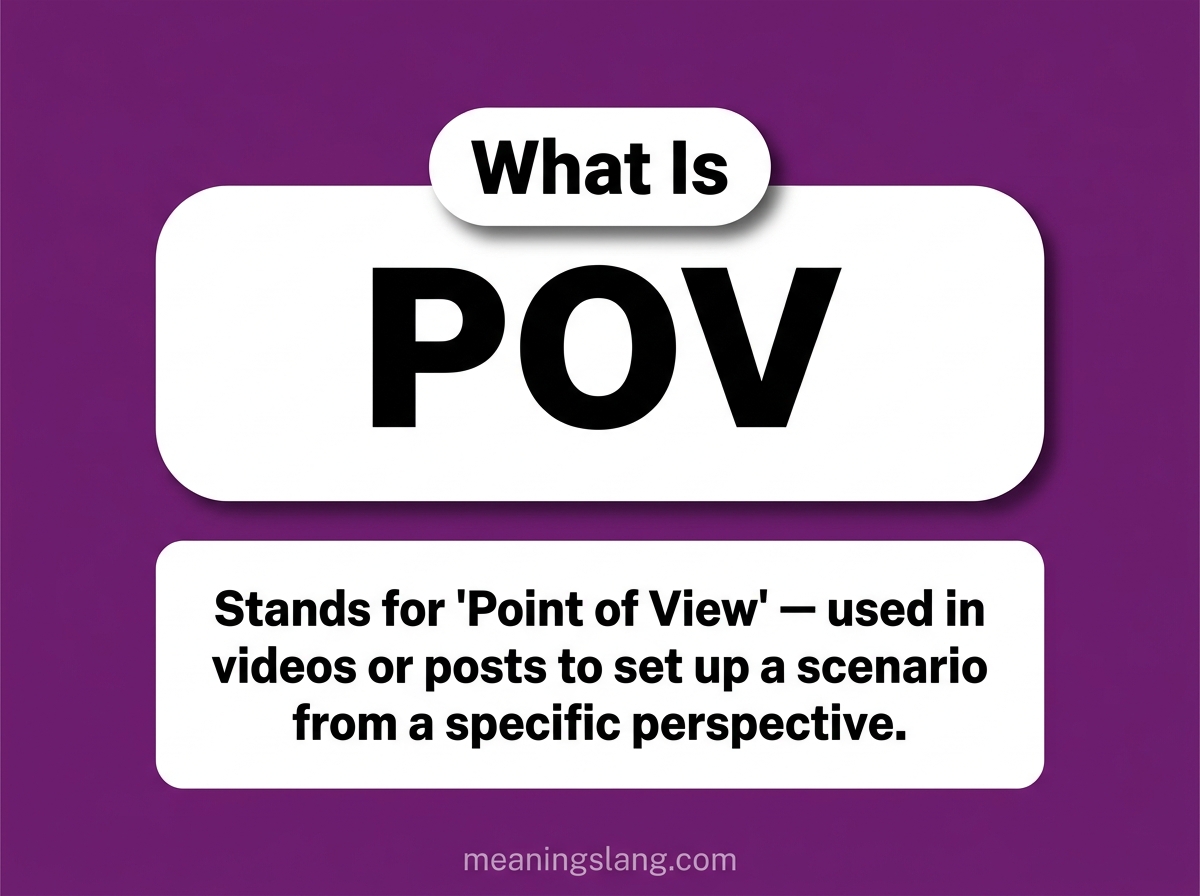
QUICK ANSWER: POV stands for “point of view.” On social media, it sets up a scenario where you imagine yourself in a specific situation. The video or text shows what that experience would be like.
Originally, POV meant exactly what it sounds like. You see something from a specific person’s perspective. In film, a POV shot shows what a character literally sees through their eyes.
Online, the meaning stretched. Now POV introduces a hypothetical scenario. When someone captions a video “POV: You’re meeting your long-distance partner at the airport,” they’re asking you to imagine being in that moment.
The tone shifts based on context. Some POV content feels emotional and sincere. A creator might make you feel what heartbreak looks like. Other times it’s completely sarcastic — “POV: You’re the friend who always cancels plans” over someone lounging on a couch.
The person posting might show their own face, not yours. That seems wrong at first. But the format evolved. Now POV means “put yourself in this situation” rather than “see through these exact eyes.”
Think of it like saying “imagine if” before a story. The phrase lost its literal meaning but gained flexibility. You might see POV used similarly to how people say IMO before sharing opinions — it frames what comes next.
[DEFINITION GRAPHIC HERE — term on left, arrow, plain definition on right, white card background]
Origin and History of “POV”
POV started in filmmaking and writing. Directors used POV shots to put audiences inside a character’s head. Horror movies loved this. You’d see the killer’s hands reaching for a door. You’d feel trapped because you were seeing through their eyes.
Writers did the same thing. “First-person POV” meant the narrator said “I” and you lived inside their thoughts.
The internet borrowed this in the early 2010s. YouTube had POV videos where you’d watch through someone’s perspective. Gaming channels showed first-person gameplay. The meaning stayed literal.
Then TikTok happened around 2019-2020. Short videos needed quick setups. Creators started using “POV:” as a caption to establish context in seconds. But holding a phone to show “your” perspective felt awkward. So they just… showed their face instead.
Nobody complained. The format worked. By 2021, POV had fully shifted. It meant “here’s a scenario” more than “here’s your literal viewpoint.”
The transformation happened fast. Film students occasionally mock how TikTok “ruined” POV. But language doesn’t care about technical accuracy. It cares about usefulness.
How “POV” Is Used on Different Platforms
TikTok
This is POV’s home base. Creators use it constantly for skits, emotional content, and comedy. Most POV TikToks show the creator acting out a character while you “experience” the scenario. “POV: Your toxic ex texts you after three months” might show someone typing furiously.
Example: “POV: You’re the only extrovert in a friend group of introverts.”
POV appears in Reels (borrowed from TikTok) and occasionally in Stories. Captions use it to add context to photos too. A travel photo might say “POV: You finally quit your job and booked the flight.”
Example: “POV: Your best friend just got engaged before you 😭”
Twitter/X
Here POV becomes more text-based. People write hypothetical scenarios without video. It’s popular for commentary and jokes. Sometimes people use it sarcastically to call out behavior.
Example: “POV: You’re a recruiter asking for 10 years experience for an entry-level job.”
Snapchat
Less common, but shows up in Stories. Usually personal and casual — showing friends a relatable moment.
Example: “POV: It’s Sunday and you haven’t done any homework.”
Discord/Gaming Chats
Gamers use POV to describe in-game scenarios or mock teammates. It often carries a roasting tone.
Example: “POV: You’re our tank and you just walked into the enemy team alone again.”
| Platform | Common Use | Tone | Example |
|---|---|---|---|
| TikTok | Skits, emotional content | Dramatic or comedic | “POV: You’re the middle child” |
| Reels, captions | Relatable, aspirational | “POV: You bought the bag” | |
| Twitter/X | Text jokes, commentary | Sarcastic, observational | “POV: You’re being gaslit by an app” |
| Snapchat | Personal stories | Casual, friendly | “POV: Monday hit different” |
| Discord | Gaming scenarios | Mocking, playful | “POV: You forgot to mute” |
POV in Texting vs. Real Life
People rarely say “POV” out loud in everyday speech. It stays mostly typed.
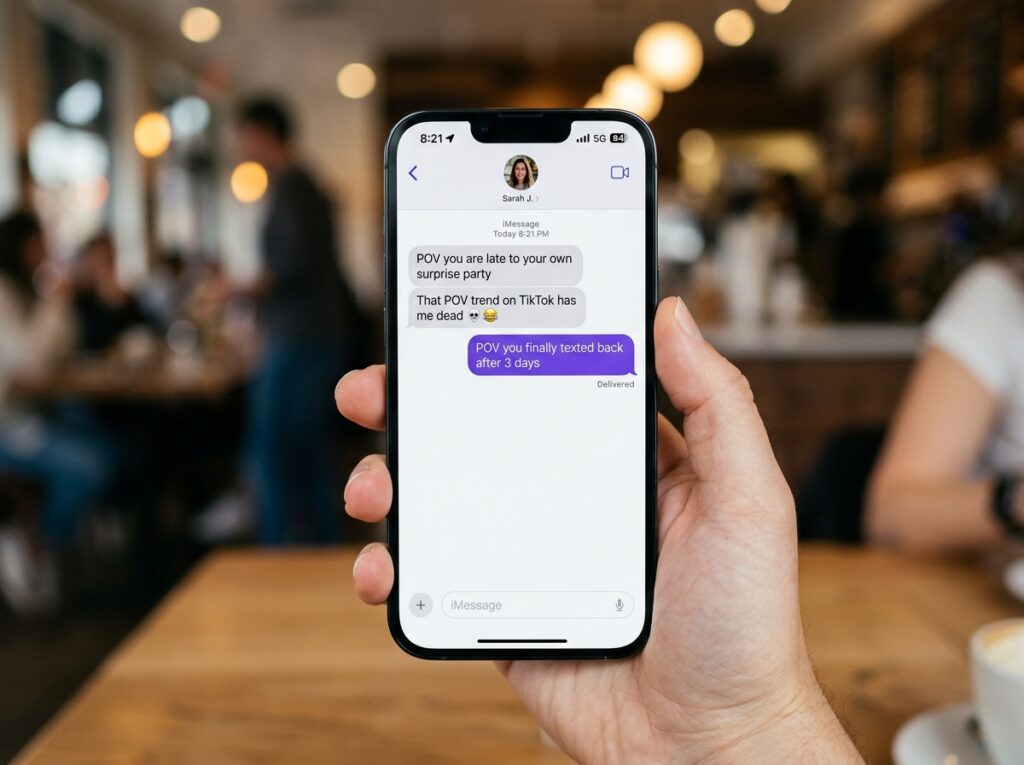
In texts, POV sets up a quick scenario. You might message a friend: “POV: You’re at work pretending to be busy.” They instantly picture it.
Spoken aloud, it sounds a bit awkward. Saying “POV colon you’re eating alone at a restaurant” feels robotic. Most people would just say “imagine you’re eating alone” instead.
The exception? Referencing TikTok. Someone might say, “That’s such a POV moment” when something relatable happens. Or they’ll joke, “This is giving POV: sad girl autumn.”
Generally, POV works better written. The format needs that visual setup — the colon, the scenario, the imagination prompt. Speaking it loses the punchiness.
Examples of “POV” in Sentences
GROUP 1 — Friendly/Casual
“POV: You’re the group chat member who only sends memes.”
“POV: Your mom is calling for dinner but you’re mid-game.”
“POV: It’s Friday at 4:59 PM and your boss sends an email.”
GROUP 2 — Romantic/Flirty
“POV: Your crush just liked your photo from 47 weeks ago.”
“POV: They actually text back immediately.”
GROUP 3 — Sarcastic/Humorous
“POV: You’re the WiFi router when everyone’s home.”
“POV: You’re my motivation to go to the gym (nonexistent).”
GROUP 4 — Online/Caption Use
“POV: You told yourself ‘just one more episode’ three hours ago.”
“POV: Main character energy finally activated ✨”
[EXAMPLE CHAT SCREENSHOT MOCKUP — fake phone chat bubbles, iMessage or WhatsApp style]
Variations and Related Slang
POV itself doesn’t have many spelling variations. You might see “pov” lowercase or “P.O.V.” with periods, but they all mean the same thing.
Related slang creates similar effects. When someone says IYKYK, they’re also creating an insider scenario — you either get it or you don’t. Both phrases build imaginary situations.
Other terms serve similar purposes. “Me when” sets up relatable moments. “That feeling when” (TFW) does the same. “This gives” describes vibes rather than perspectives.
Based content often pairs with POV. A “based POV” means the scenario shows someone being unapologetically themselves.
| Term | Meaning | Similar/Different? |
|---|---|---|
| POV | Point of view, scenario setup | — |
| TFW | That feeling when | Similar — sets up emotions |
| Me when | Personal relatable moment | Similar — scenario-based |
| IYKYK | If you know, you know | Different — insider reference |
| This gives | Describes a vibe or energy | Different — observation, not perspective |
Is “POV” Safe for Kids?
Short answer: Yes, POV itself is completely safe.
The term just means “point of view.” There’s nothing inappropriate about the phrase. Kids use it constantly in school projects, creative writing, and casual conversation.
The concern isn’t the word — it’s the content. Some POV videos on TikTok cover mature topics. Relationship drama, mental health struggles, or adult humor can use the POV format. The phrase doesn’t make content inappropriate, but it doesn’t make it appropriate either.
Parents should watch what POV videos their kids consume, not worry about the term. If your child uses “POV” in texts or captions, that’s normal Gen Z communication.
Teachers won’t flag “POV” as concerning. Schools actually teach point of view in English class. Kids sometimes mix up the literary definition with the TikTok version, but both are acceptable.
Monitor content, not vocabulary. POV is just a setup phrase.
[PARENT SAFETY ICON — shield/safety graphic, 300x200px, “Parent Guide” label]
When to Use (and Avoid) “POV”
USE IT WHEN:
- Creating relatable content that invites people into a scenario
- Making TikToks, Reels, or social media posts
- Texting friends about funny hypothetical situations
- Adding creative framing to a caption or story
AVOID IT WHEN:
- Writing formal emails or professional documents
- Speaking out loud in most contexts (it sounds unnatural)
- The scenario doesn’t actually need perspective framing
- You’re using it so much it loses impact
Conclusion
POV means “point of view” — but online, it’s become a scenario-setting tool. When you see “POV:” before a caption or video, someone’s inviting you to imagine a specific moment. The literal camera angle doesn’t matter anymore.
This evolution shows how internet culture reshapes language. Words gain new functions based on how millions of people actually use them. POV became less about filmmaking technique and more about shared imagination.
The term isn’t going anywhere. If anything, expect more creative variations. Similar to how SMH expresses reactions instantly, POV gives people a quick way to build worlds in seconds. That’s powerful shorthand.
Next time someone asks what POV means, you’ve got the full picture.
FAQ
FAQ #1: What does POV mean on TikTok?
On TikTok, POV stands for “point of view” and introduces a scenario you should imagine yourself in. The creator sets up a situation with text, then acts it out. You’re meant to picture yourself experiencing that moment, even if you’re watching their face.
FAQ #2: Why do people use POV wrong on TikTok?
Many TikTokers show their own face instead of your literal viewpoint. This isn’t technically “wrong” — the meaning evolved. POV now means “imagine this scenario” rather than strictly showing what your eyes would see. The format changed to fit short-video storytelling.
FAQ #3: Is POV only used on social media?
No. POV originated in film and literature to describe perspective. Writers use first-person POV. Directors use POV shots. Social media popularized a looser meaning, but the original definitions still exist in creative writing, filmmaking classes, and formal contexts.
FAQ #4: Can I use POV in regular texting?
Absolutely. People text things like “POV: you’re me checking my bank account” to share relatable moments with friends. It works best for hypothetical scenarios or jokes. Keep it casual — POV fits informal conversations, not professional messages.
FAQ #5: What’s the difference between POV and “me when”?
Both set up relatable scenarios, but POV asks you to imagine being someone while “me when” shows the speaker’s reaction. “POV: You’re waiting for results” puts you there. “Me when I check my grades” shows their personal response. Similar energy, slightly different framing.