Someone just texted you their opinion on a movie, and then added “IIRC” at the end. You stared at it. You read it again. Still nothing.
Maybe you nodded along and pretended you understood. Or maybe you came straight here because you hate feeling lost in your own group chat.
IIRC shows up constantly in texts, Reddit threads, and Twitter arguments. It’s one of those acronyms people throw around like everyone was born knowing it. But here’s the thing — it’s actually useful once you get it.
This little four-letter phrase signals something specific about confidence and memory. It’s not showing off. It’s not rude. It sits in the same family as SMH — short, punchy, and packed with meaning.
The good news? IIRC is simple to learn. You’ll understand it in about thirty seconds. And once you do, you’ll start noticing it everywhere.
Let’s get into what it actually means.
What Does IIRC Mean?
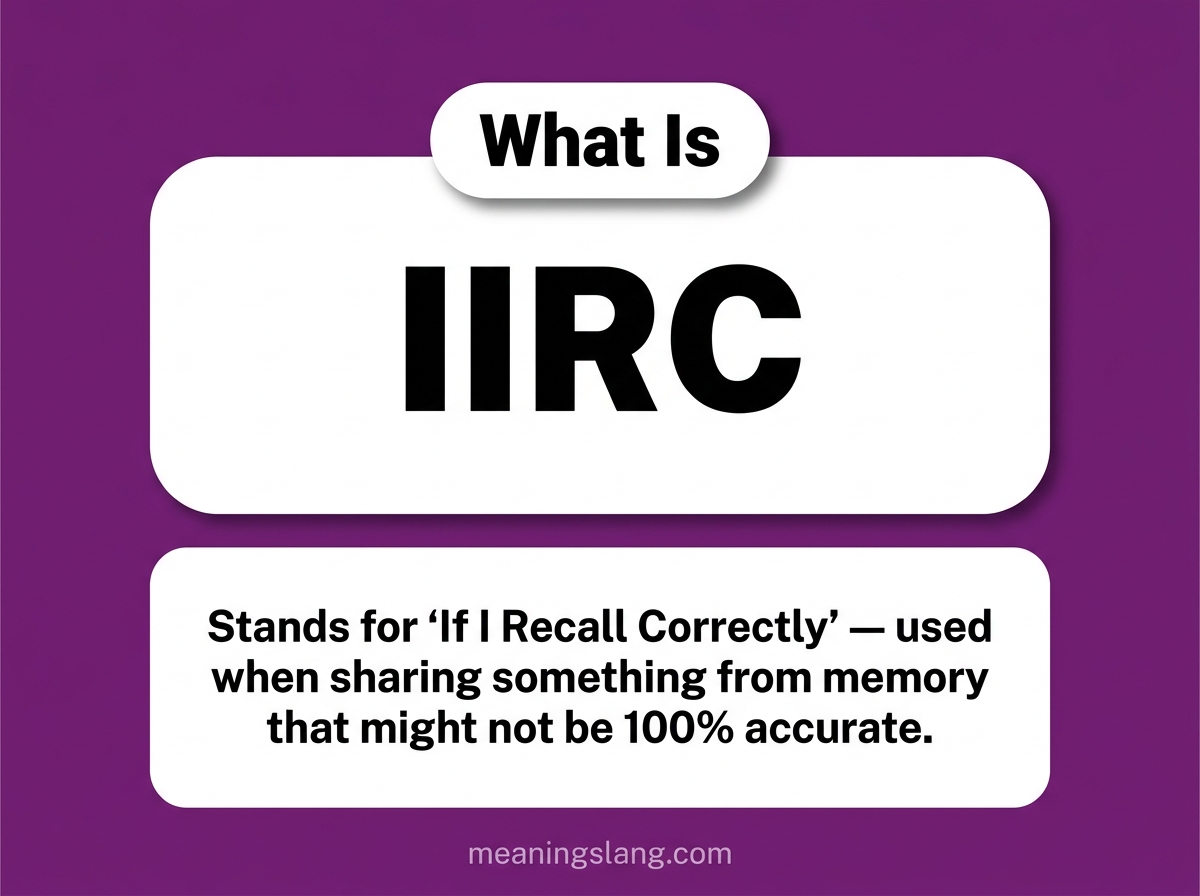
QUICK ANSWER: IIRC stands for “If I Recall Correctly.” It means “I think this is right, but I’m not 100% sure.” People use it before sharing information they believe is accurate but can’t fully confirm.
Now let’s break it down a bit more.
IIRC is a humble phrase. When someone uses it, they’re giving you information while admitting their memory might be off. It’s like saying, “Don’t quote me on this, but…”
The tone is casual and honest. There’s no cockiness here. Someone typing “IIRC, the concert starts at 8” is sharing what they remember without pretending they checked twice.
This separates IIRC from phrases like IMO, which shares an opinion. IIRC shares a memory. Big difference. You’d say “IMO that movie was mid” but “IIRC that movie came out in 2019.”
The phrase works the same no matter who uses it. A Gen Z kid texting friends uses it the same way a 40-year-old uses it on Reddit. It’s universal internet speak at this point.
You’ll often see IIRC at the start of a sentence: “IIRC, she already has a boyfriend.” Sometimes it lands at the end: “The deadline was Friday, IIRC.”
Either placement works. The meaning stays identical.
[DEFINITION GRAPHIC HERE — term on left, arrow, plain definition on right, white card background]
Origin and History of “IIRC”
IIRC isn’t new. It’s actually one of the oldest internet acronyms still in heavy rotation.
The phrase popped up in the early 1990s on Usenet forums. These were basically the group chats of the pre-social-media internet. People typing long posts needed shortcuts. IIRC became a fast way to hedge your statements.
Back then, you couldn’t just Google something mid-conversation. If you wanted to mention a fact, you had to rely on memory. Adding IIRC let you share without claiming perfect accuracy.
By the mid-2000s, IIRC had migrated to forums, chat rooms, and early texting culture. It never went viral in a flashy way. Instead, it quietly became standard vocabulary for anyone who spent time typing online.
Today it’s everywhere — Reddit, Twitter, Discord, group texts. The phrase survived multiple internet generations because it solves a real problem. Everyone needs to say “I think so, but maybe not” sometimes.
How “IIRC” Is Used on Different Platforms
Different platforms shape how IIRC lands. Here’s where you’ll see it most.
TikTok
IIRC appears in comments more than videos. Someone might comment, “IIRC she addressed this in her last video.” It’s a quick way to reference something without rewatching first. Tone stays helpful, not bossy.
Twitter/X
Twitter loves IIRC. The character limit means every letter counts. Someone debating politics or sports might write, “IIRC, he said the opposite in 2022.” It adds credibility while leaving room for error.
Reddit is IIRC’s natural habitat. Long threads about niche topics rely on user memory. “IIRC, that episode was season 3” is classic Reddit energy. Tone here is collaborative — everyone’s helping piece things together.
Discord/Gaming Chats
Gamers use IIRC when discussing patch notes, lore, or old matches. “IIRC, they nerfed that weapon last update.” It fits naturally between fast messages.
Less common here. When it shows up, it’s usually in DM conversations or caption replies. “IIRC we met at Jake’s party?” keeps things light.
| Platform | Common Use | Tone | Example |
|---|---|---|---|
| TikTok | Comments referencing past content | Helpful | “IIRC she talked about this before” |
| Twitter/X | Debates, fact discussions | Confident but hedged | “IIRC the stats show otherwise” |
| Detailed thread contributions | Collaborative | “IIRC that theory was debunked” | |
| Discord | Gaming discussions, lore | Casual | “IIRC the boss drops rare loot” |
| DMs, casual replies | Friendly | “IIRC you said you liked Thai food” |
IIRC in Texting vs. Real Life
IIRC lives almost entirely in text. You’ll rarely hear someone say the letters out loud.
In spoken conversation, people just say the full phrase: “If I recall correctly” or “If I remember right.” Saying “eye-eye-are-see” out loud sounds robotic. Most people avoid it.
But in texts and chats? IIRC flows perfectly. It’s faster to type and everyone understands it. The meaning doesn’t shift between platforms — it stays consistent.
If you ever hear someone actually say “IIRC” aloud, they’re probably being ironic or very online. It happens, but it’s rare.
Examples of “IIRC” in Sentences
GROUP 1 — Friendly/Casual
- “IIRC, the restaurant closes at 10.”
- “She moved to Denver last year, IIRC.”
- “IIRC, you said you were free this weekend?”
GROUP 2 — Romantic/Flirty
- “IIRC, you owe me a coffee date.”
- “You said you liked surprises, IIRC 😉”
GROUP 3 — Sarcastic/Humorous
- “IIRC, you said you’d ‘definitely’ be on time today.”
- “That’s funny because IIRC you called that movie trash last month.”
GROUP 4 — Online/Caption Use
- “IIRC this trend started on TikTok.”
- “The original tweet got deleted, but IIRC it was way worse.”
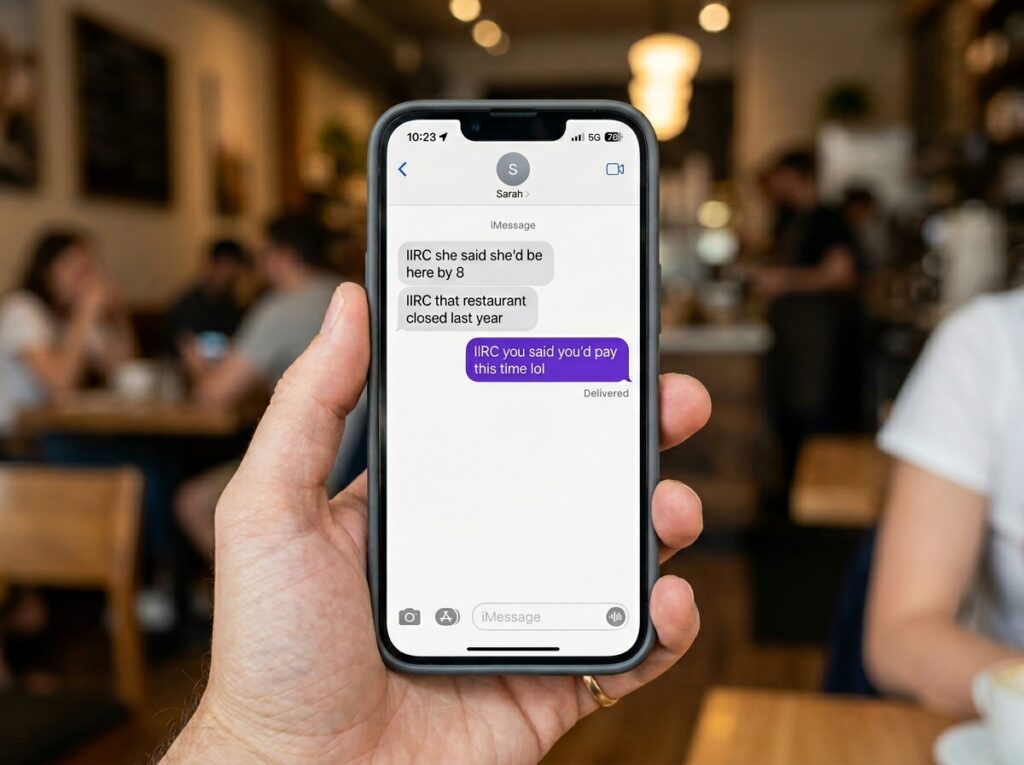
[EXAMPLE CHAT SCREENSHOT MOCKUP — fake phone chat bubbles, iMessage or WhatsApp style]
Variations and Related Slang
IIRC doesn’t have many spelling variations. Some people write it lowercase (iirc), which is equally common and accepted. That’s about it.
But plenty of related acronyms exist for hedging or sharing opinions:
- IMO — “In My Opinion.” Shares a viewpoint, not a memory.
- AFAIK — “As Far As I Know.” Similar hedging energy, slightly different vibe.
- TBH — “To Be Honest.” Often adds sincerity to a statement.
- FWIW — “For What It’s Worth.” Adds casual disclaimer energy.
Similar to NGL, IIRC softens what you’re about to say. But NGL signals honesty while IIRC signals uncertainty.
| Term | Meaning | Similar/Different? |
|---|---|---|
| IIRC | If I Recall Correctly | — |
| IMO | In My Opinion | Different — opinion vs. memory |
| AFAIK | As Far As I Know | Similar — both hedge facts |
| TBH | To Be Honest | Different — signals sincerity |
| FWIW | For What It’s Worth | Similar — both add disclaimers |
Is “IIRC” Safe for Kids?
Yes, IIRC is completely safe for kids.
The phrase has zero inappropriate meanings. It’s just a polite way to share uncertain information. No slang evolution has twisted it into anything edgy.
Kids using IIRC in texts or comments are just communicating clearly. If anything, it’s a sign of good communication habits — admitting when you’re not totally sure about something.
Parents don’t need to worry here. Teachers wouldn’t flag this. Schools wouldn’t care. It’s as harmless as saying “I think so.”
The only thing to watch for? Make sure kids know what it means. Otherwise, they might misuse it or feel confused when they see it. A quick explanation handles that.
[PARENT SAFETY ICON — shield/safety graphic, 300x200px, “Parent Guide” label]
When to Use (and Avoid) “IIRC”
USE IT WHEN:
- You’re sharing information from memory, not confirmed facts
- You want to sound helpful without claiming certainty
- You’re in casual online conversations or texts
- You’re discussing something and can’t double-check right now
AVOID IT WHEN:
- You’re writing something formal (work emails, school essays)
- You actually know the answer with certainty
- You’re talking to someone unfamiliar with internet slang
- The context requires precision — legal stuff, medical advice, etc.
Conclusion
IIRC means “If I Recall Correctly.” It’s a simple, humble way to share information while admitting your memory might not be perfect.
This little acronym shows how internet language values honesty. People want to help each other without pretending they know everything. That’s actually pretty healthy communication.
Slang like IIRC builds connection. It says, “I’m trying to help, but I’m human too.” Similar to understanding what OFC means, learning these shortcuts makes online conversations flow smoother.
Now you can use IIRC confidently — or at least recognize it when it pops up next time.
FAQ
What does IIRC stand for?
IIRC stands for “If I Recall Correctly.” It signals that you’re sharing something from memory but aren’t completely certain it’s accurate. People use it to hedge their statements online.
Is IIRC rude or passive-aggressive?
No, IIRC isn’t rude at all. It’s actually humble and polite. You’re admitting uncertainty rather than stating something as absolute fact. Most people appreciate the honesty.
Can I use IIRC in professional emails?
It’s better to avoid IIRC in formal work communication. Spell out “If I recall correctly” instead. Acronyms like this can seem too casual for professional contexts.
Is IIRC the same as IMO?
No, they serve different purposes. IIRC hedges a memory or fact. IMO introduces a personal opinion. You’d use IIRC for “I think the meeting was Tuesday” and IMO for “I think the meeting was pointless.”
Do people say IIRC out loud?
Rarely. Most people say the full phrase “if I recall correctly” when speaking. Saying the letters out loud sounds awkward. IIRC is designed for typing, not talking.