Your kid just screamed “Skibidi Toilet!” while running through the house. You have no idea what that means. You’re not alone.
This phrase has completely taken over playgrounds, group chats, and TikTok comment sections. It sounds like pure nonsense. And honestly? It kind of is. But that’s exactly why younger generations love it.
Skibidi Toilet started as a weird YouTube series. Now it’s become a massive cultural moment. The animation features singing heads popping out of toilets. Yes, really. They battle against humanoid figures with cameras and speakers for heads.
If you’ve seen kids doing a strange head-bobbing dance, that’s the Skibidi Toilet influence. It’s bizarre, catchy, and surprisingly addictive. The series has billions of views. Billions.
Understanding Skibidi Toilet helps you connect with what younger people find funny right now. It’s also similar to understanding what the sigma means — both are absurdist memes that spread like wildfire. The meaning goes deeper than just a silly video.
What Does Skibidi Toilet Mean?
QUICK ANSWER: Skibidi Toilet refers to a viral animated YouTube series featuring human heads singing from inside toilets. The term now describes anything absurdly random, chaotic, or “brainrot” content. People use it to reference the series or to describe something hilariously weird.
The phrase has two main meanings in 2026.
First, it’s the name of the actual series created by Alexey Gerasimov (DaFuq!?Boom!). The show features a war between toilet-dwelling singing heads and humanoid figures called Cameramen, Speakermen, and TV Men. Each episode lasts about 30 seconds to a few minutes.
Second, “Skibidi Toilet” has become slang for anything absurd or terminally online. When someone says “that’s so Skibidi Toilet,” they mean it’s random, chaotic, or peak internet weirdness.
The tone is playful and self-aware. Older users often use it sarcastically. They’ll say “Skibidi Toilet has cooked us” to joke about how strange internet culture has become. Younger fans use it genuinely. They love the chaos.
If a friend sends you a truly unhinged meme, you might respond “this is Skibidi Toilet energy.” That means it’s weird in a good way. The term captures that specific flavor of Gen Alpha humor — loud, fast, and completely random.
People also type SMH when reacting to Skibidi Toilet content. It’s become a cultural touchstone for discussing internet brainrot.
[DEFINITION GRAPHIC HERE — term on left, arrow, plain definition on right, white card background]
Origin and History of “Skibidi Toilet”
The Skibidi Toilet series launched on YouTube in February 2023. Creator DaFuq!?Boom! made it using Source Filmmaker. The first video showed a head in a toilet singing a distorted version of a Turkish song.
That Turkish song was “Dom Dom Yes Yes” by Biser King. The “Skibidi” sound comes from the song’s catchy hook. The creator sped it up and distorted it. Paired with the toilet visual, it became instantly memeable.
The series exploded. Each new episode added characters and lore. What started as a one-off joke became an ongoing saga. By late 2023, it had over 65 episodes. By 2024, over 75. By 2026, it’s still going.
Kids latched onto it hard. The short format matched their attention spans. The absurdity matched their humor. Merchandise appeared everywhere. Skibidi Toilet toys sold out constantly.
The phrase “Skibidi” itself existed before the series — it comes from the Skibidi dance trend from 2018. But “Skibidi Toilet” specifically refers to this YouTube phenomenon.
How “Skibidi Toilet” Is Used on Different Platforms
TikTok
TikTok runs on Skibidi Toilet content. Users create edits, reaction videos, and parodies. The audio gets used under random chaos clips. Example: “POV: You showed your mom Skibidi Toilet and she thinks you need therapy.”
On Instagram, Skibidi Toilet appears in meme pages and Reels. Captions joke about being “infected” by it. Stories use the audio ironically. Example: “My brain after watching one Skibidi Toilet episode 📉”
Twitter/X
Twitter users discuss Skibidi Toilet as a cultural phenomenon. Some celebrate it. Others post “we have failed as a society.” Both reactions fuel its popularity. Example: “Skibidi Toilet lore is deeper than some Netflix shows.”
Discord/Gaming Chats
Gaming servers reference it constantly. Players use Skibidi Toilet characters as profile pictures. They spam “Skibidi” in chat for chaos. Example: “Why is your username SkibidiGamer? Are you 9?”
Reddit has entire subreddits dedicated to the series. Fans analyze the plot. Critics debate if it’s “brainrot” or genuine art. Example: “Skibidi Toilet unironically has better worldbuilding than some AAA games.”
| Platform | Common Use | Tone | Example |
|---|---|---|---|
| TikTok | Edits and audio trends | Playful/chaotic | “Skibidi Toilet explained in 30 seconds” |
| Memes and Reels | Ironic/humorous | “This show lives in my head rent-free” | |
| Twitter/X | Cultural commentary | Sarcastic/analytical | “We’re living in the Skibidi Toilet timeline” |
| Discord | Spam and inside jokes | Chaotic/playful | “SKIBIDI BOP BOP YES YES” |
| Lore discussions | Genuine/critical | “The Cameraman arc was peak cinema” |
Skibidi Toilet in Texting vs. Real Life
Texting uses “Skibidi Toilet” as shorthand for absurdity. You’d type “that’s giving Skibidi Toilet” to call something random. The phrase works in DMs, comments, and group chats.
In real life, kids absolutely say it out loud. They sing the tune. They do the head-bob dance. It’s unavoidable on playgrounds and in classrooms.
Adults mostly use it ironically when speaking. Saying “Skibidi Toilet” seriously as an adult sounds ridiculous. That’s part of the joke. The generational gap makes it funnier.
Typed, it reads as commentary on internet culture. Spoken, it’s either genuine fandom or sarcastic millennial exhaustion.
Examples of “Skibidi Toilet” in Sentences
GROUP 1 — Friendly/Casual
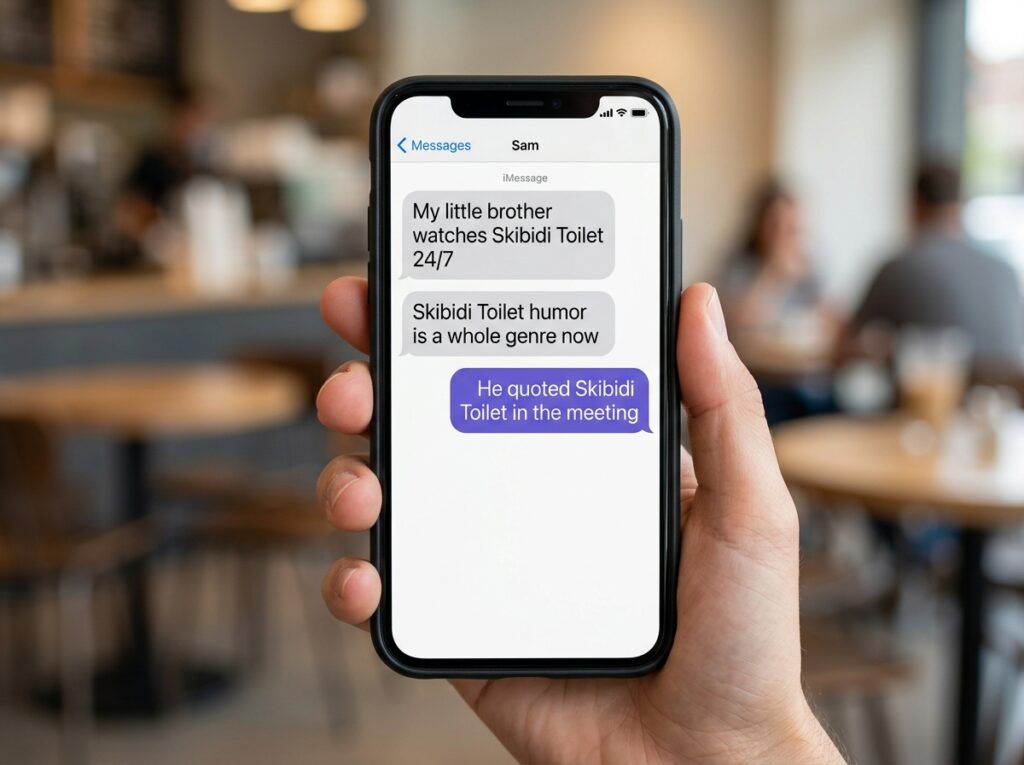
“My little brother watches Skibidi Toilet on repeat every single day.”
“Have you seen the newest Skibidi Toilet episode? The lore is insane.”
“This meme has major Skibidi Toilet vibes, honestly.”
GROUP 2 — Sarcastic/Humorous
“My brain is just Skibidi Toilet on loop at this point.”
“Society peaked with Skibidi Toilet and it’s been downhill since.”
GROUP 3 — Commentary/Cultural
“Skibidi Toilet is what happens when Gen Alpha gets internet access.”
“I tried explaining Skibidi Toilet to my mom. She’s concerned.”
GROUP 4 — Online/Caption Use
“When the Skibidi Toilet hits different at 3am 😭”
“POV: You finally understand the Skibidi Toilet lore”
“This is the most Skibidi Toilet thing I’ve ever posted.”
[EXAMPLE CHAT SCREENSHOT MOCKUP — fake phone chat bubbles, iMessage or WhatsApp style]
Variations and Related Slang
The core phrase stays consistent: “Skibidi Toilet.” Some spell it “Skibbidi” or “Skibiddy” by mistake. The correct spelling matches the original series title.
Related terms show how this fits into broader internet culture. Understanding these helps you navigate Gen Alpha and Gen Z humor.
Brainrot describes content that “rots” your brain — meaningless but addictive. Skibidi Toilet is peak brainrot.
Cameraman/Speakerman are characters from the series. Kids reference them like superheroes.
NPC behavior relates here too. The NPC meaning describes robotic, scripted actions — and Skibidi Toilet characters move in that uncanny way.
Sigma energy sometimes gets compared to Cameraman. Both represent a certain cool, unbothered vibe in meme culture.
Cooked means something is destroyed or done. Fans say “the Toilets are cooked” when they lose battles.
| Term | Meaning | Similar/Different? |
|---|---|---|
| Skibidi Toilet | Viral series + absurd content | — |
| Brainrot | Addictive low-effort content | Skibidi Toilet is an example |
| NPC | Acting robotic/scripted | Characters have NPC energy |
| Cooked | Destroyed/finished | Used about the series |
| Based | Cool, admirable | Cameraman is “based” |
Is “Skibidi Toilet” Safe for Kids?
Direct answer: Mostly yes, but context matters.
The original Skibidi Toilet series contains animated violence. Characters fight and get destroyed. There’s no blood or gore. The style is cartoonish and silly. Most parents compare it to old-school cartoon violence.
The bigger concern is time spent watching. The short-form format makes it endlessly scrollable. Kids can watch for hours without realizing it. That’s the real issue — screen addiction, not inappropriate content.
Some fan-made content crosses lines. Always check what your child watches. Official DaFuq!?Boom! videos stay family-friendly. Parody videos might not.
The phrase itself isn’t offensive. Kids use it on playgrounds without problems. Teachers might find it annoying. It’s not something that would get flagged as inappropriate.
Talk to your kids about what they watch. Understanding their interests builds connection. Just prepare yourself for explaining why a singing toilet head is apparently hilarious.
[PARENT SAFETY ICON — shield/safety graphic, 300x200px, “Parent Guide” label]
When to Use (and Avoid) “Skibidi Toilet”
USE IT WHEN:
- Joking about absurd or chaotic content
- Connecting with younger family members or students
- Commenting on peak internet weirdness ironically
- Referencing the actual series in fan communities
AVOID IT WHEN:
- In professional or formal settings
- With people who won’t understand the reference
- Overusing it to seem relatable (kids will notice)
- Making fun of kids who genuinely enjoy it
Conclusion
Skibidi Toilet means the viral YouTube series about singing toilet heads — and by extension, any content that’s absurdly chaotic and terminally online.
This phrase shows how internet culture creates its own language. What seems like nonsense actually connects millions of people. It’s a shared joke, a reference point, a cultural moment.
The next time a kid screams “Skibidi” at you, you’ll know exactly what they mean. And maybe you’ll even appreciate the weird beauty of it. Understanding slang like this — or terms like gyatt — keeps you connected to how language evolves in real time.
FAQ
FAQ #1: What does “Skibidi Toilet” mean in simple terms?
Skibidi Toilet is a YouTube animated series featuring human heads in toilets that sing and battle camera-headed humanoids. The phrase also describes anything absurdly random or chaotic. Kids use it to reference the show or describe weird internet content.
FAQ #2: Is Skibidi Toilet appropriate for children?
The original series is generally kid-friendly with cartoonish animated violence. No blood or explicit content appears. However, endless viewing can become a screen-time issue. Fan-made content varies in appropriateness, so monitor what kids actually watch.
FAQ #3: Why is Skibidi Toilet so popular with kids?
The short-form videos match young attention spans perfectly. The absurd humor appeals to developing senses of comedy. The ongoing lore creates engagement. Plus, anything parents don’t understand becomes cooler by default.
FAQ #4: Where did the word “Skibidi” come from?
“Skibidi” originates from the distorted Turkish song “Dom Dom Yes Yes” by Biser King. The creator sped up the “Skibidi dop dop” part. It also connects to the 2018 Skibidi dance trend by Little Big, though the toilet series made it viral again.
FAQ #5: Can adults use “Skibidi Toilet” without sounding weird?
Adults typically use it ironically to comment on internet culture. Saying it genuinely might sound awkward. Using it to connect with kids works if you don’t overdo it. Self-aware, sarcastic usage fits adult conversation better than sincere fandom.