You are scrolling through your messages and a friend mentions their “CFS.” You might feel a sudden spike of confusion. Are they talking about a medical condition? Or maybe a new gaming term you missed? In the world of social media, missing one acronym can make you feel totally left out. It happens to everyone at some point.
Usually, someone says this when they have shared a secret or a funny photo. They might say, “I posted the drama on my CFS.” This is similar to how people use icl-meaning to share honest thoughts with a small group. It signals that you are part of an inner circle. If you are not on the list, you simply won’t see the content. It is a way to filter who sees your life.
The term has become a staple of digital privacy. It changes how we share our daily moments with others.
What Does CFS Mean?
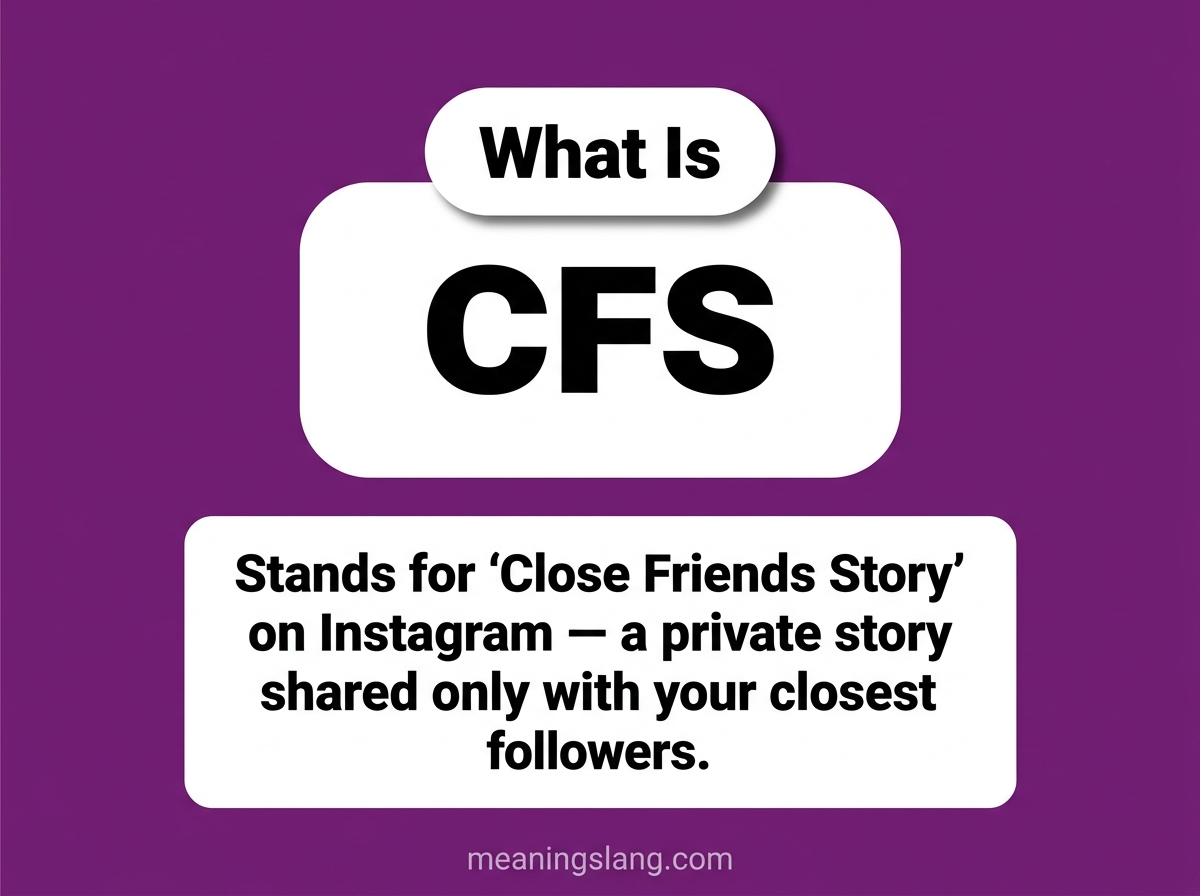
CFS most commonly stands for Close Friends Story. It refers to a specific feature on Instagram. This feature lets you create a private list of followers. When you post a story to this list, only those people can see it.
The tone of a CFS is usually relaxed and raw. People use it to share things they do not want their boss or parents to see. Many people use their CFS to be more honest, similar to how ngl-meaning is used for candid moments. It feels more personal than a public post. It is the digital version of a “best friends only” club.
If someone adds you to their CFS, it means they trust you. It is a sign of a closer social bond. You might see “CFS” used as a noun or a verb. Someone might say they are “CFS-ing” a specific photo. This means they are choosing to keep it private.
[DEFINITION GRAPHIC HERE — term on left, arrow, plain definition on right, white card background]
Origin and History of “CFS”
Instagram launched the Close Friends feature in November 2018. Before this, users had to make their whole account private. Or they had to create a second, secret account. These secret accounts were often called “Finstas.”
The acronym CFS gained popularity shortly after the feature arrived. It was faster to type than the full name. It started in the comments and captions of Gen Z users. Over time, it moved into daily text conversations.
The meaning has stayed very consistent since it began. While other slang terms change every month, CFS is tied to a specific app tool. This makes it a very stable part of internet language. It solved the problem of oversharing with strangers.
How “CFS” Is Used on Different Platforms
Instagram is the primary home for this term. It is where the feature actually lives. You will see people post “Add me to your CFS” in their public stories. This is a way to ask for a deeper connection.
On TikTok, people often talk about their CFS in videos. They might share screenshots of funny things they posted there. You might see people talking about their CFS on other apps too, because yk-meaning how news travels fast. It is a common topic for “storytime” videos.
Snapchat has a similar feature called Private Stories. However, people still use the term CFS to describe the concept. It has become a universal word for “private social media circle.”
| Platform | Common Use | Tone | Example |
|---|---|---|---|
| Defining a viewer list | Private | “Check my CFS for the tea.” | |
| TikTok | Discussing private posts | Humorous | “When he posts her on his CFS.” |
| X (Twitter) | Complaining about lists | Sarcastic | “Why am I on your CFS?” |
CFS in Texting vs. Real Life
In texting, CFS is a quick way to discuss privacy. It is almost always written in lowercase. You will see it in group chats most often. It saves time when someone wants to mention a specific post.
In real life, people actually say the letters out loud. They pronounce it “C-F-S.” It sounds natural in casual conversation among younger people. You might hear someone say, “I saw that on your CFS yesterday.”
It doesn’t sound weird when spoken because it is so common. However, you probably won’t hear it in a business meeting. It remains a term for social and personal life. It bridges the gap between our digital and physical friendships.
Examples of “CFS” in Sentences
GROUP 1 — Friendly/Casual
- I only post my ugly selfies on my CFS.
- Wait, did you see what she put on her CFS?
- I need to clean out my CFS list this weekend.
GROUP 2 — Romantic/Flirty
- He finally added me to his CFS last night!
- I’m tempted to post a thirst trap on my CFS.
GROUP 3 — Sarcastic/Humorous
- My CFS is just me crying about my midterms.
- You know it’s serious when you get the CFS invite.
GROUP 4 — Online/Caption Use
- Reply to this if you want to be on my CFS.
- The CFS was popping off today.
[EXAMPLE CHAT SCREENSHOT MOCKUP — fake phone chat bubbles, iMessage or WhatsApp style]
Variations and Related Slang
The most common variation is simply “CF.” This stands for Close Friends. People use these terms interchangeably. Some people might also call it their “Green Circle” because the icon is green.
A “Finsta” is a related term. This is a fake Instagram account used for the same purpose. This is a common way to soft-launch-meaning a new relationship without telling everyone.
| Term | Meaning | Similar/Different? |
|---|---|---|
| CFS | Close Friends Story | The standard term. |
| CF | Close Friends | A shorter version. |
| Finsta | Fake Instagram | A separate private account. |
| Private Story | Snapchat version | Same idea, different app. |
Is “CFS” Safe for Kids?
Yes, the term itself is safe. It is a neutral acronym for a software feature. There are no hidden inappropriate meanings. However, parents should know how the feature works.
Because a CFS is private, kids might feel they can post riskier content. They might share things they wouldn’t want a parent to see. It can also be used to exclude certain friends. This can sometimes lead to feelings of being left out.
Teachers generally don’t flag the word. It is a normal part of how students talk about their day. It is a good idea to talk to kids about what they share. Privacy is great, but nothing online is ever 100% permanent.
[PARENT SAFETY ICON — shield/safety graphic, 300x200px, “Parent Guide” label]
When to Use (and Avoid) “CFS”
USE IT WHEN:
- You are talking about Instagram privacy settings.
- You want to tell a friend about a private post.
- You are joking about who is in your inner circle.
- You are explaining why someone can’t see your story.
AVOID IT WHEN:
- You are talking to someone who doesn’t use social media.
- You are in a formal or professional setting.
- You are talking about a medical issue (to avoid confusion).
- You want to be inclusive of everyone in a large group.
Conclusion
CFS is a simple way to describe your private world on Instagram. It stands for Close Friends Story. It helps people feel safe while sharing their real lives. This term is all about trust and community. It keeps your private life private, which is ofc-meaning a big deal today. Using it shows you understand the unwritten rules of the internet. It is a small word that carries a lot of social weight.
FAQ
FAQ #1: Does CFS mean something else in medicine?
Yes, in a medical context, CFS stands for Chronic Fatigue Syndrome. This is a serious condition that causes extreme tiredness. You can usually tell which meaning someone is using based on the conversation. If they are talking about Instagram or “posting,” they mean Close Friends Story.
FAQ #2: How do I know if I am on someone’s CFS?
On Instagram, you will know you are on a CFS list if the story ring is green. Normally, story rings are pink and orange. When you view the story, a green “Close Friends” badge will appear at the top. You cannot see the full list of other people.
FAQ #3: Can I see a CFS if I am not on the list?
No, there is no way to see a CFS unless the user adds you. The feature is designed to be secure. Even if you have a mutual friend, the post will not appear for you. This is why many people use it for sharing secrets or personal updates.
FAQ #4: Is CFS different from a Private Story on Snapchat?
They are very similar in function but live on different apps. Both allow you to select a specific group of viewers. However, “CFS” is a term specifically born from Instagram’s “Close Friends” branding. On Snapchat, people usually just call them “Privates” or “Private Stories.”
FAQ #5: Can people see if I remove them from my CFS?
No, Instagram does not send a notification when you remove someone. They will simply stop seeing the green circles on your profile. They might notice eventually if they realize they haven’t seen your private updates in a long time. It is a quiet way to manage your social circle.