You are in the middle of a heated debate in the group chat. Everyone is arguing about which movie is the best. Suddenly, someone sends four letters: SYFM. The chat goes silent for a second. You feel that sharp sting of a conversation ending abruptly.
It looks like a code, but the vibe feels aggressive. You know it isn’t a compliment. This term is a digital way of slamming a door in someone’s face. It is sharp, fast, and very clear about its intent.
You see it most often when patience has run out. Understanding it helps you navigate messy online interactions. It is one of those terms that can change the mood of a room instantly. People use it to take control of a conversation by ending it.
Most users know it is a high-intensity insult. It carries a lot of weight for such a short acronym. It tells you exactly where you stand with the other person.
What Does SYFM Mean?
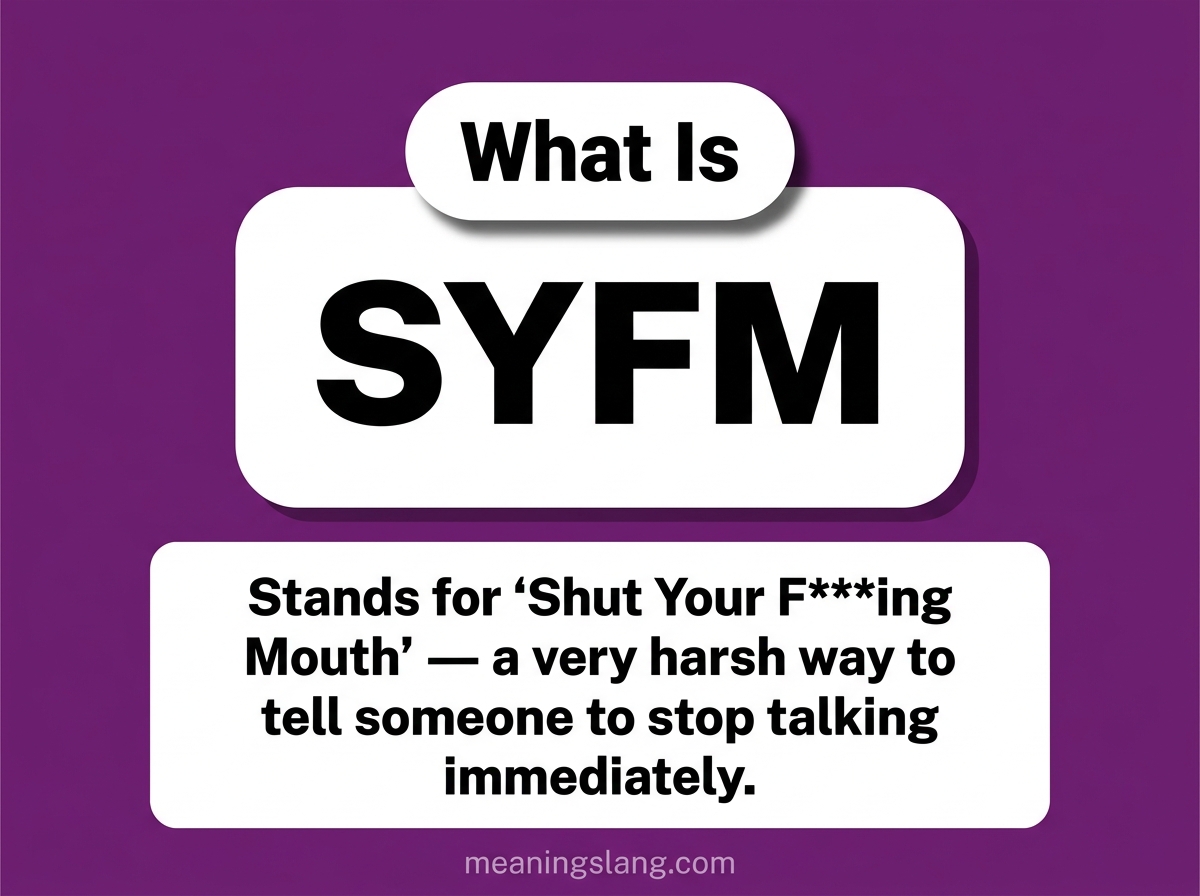
SYFM stands for Shut Your F*ing Mouth**. It is a harsh way to tell someone to stop talking immediately. People use this when they are truly annoyed or angry.
It is much more aggressive than just saying “be quiet.” The “F” in the middle adds a layer of intensity. You might see it used when someone is spreading rumors. It also pops up when a person is being incredibly annoying.
Sometimes, very close friends use it as a joke. However, it is usually a sign that someone is [pmo-meaning] and needs space. The tone is almost always confrontational. If a stranger sends this to you, they are likely trying to start a fight.
It is a common tool for “trolls” who want to shut down a debate. You will rarely see it used in a supportive way. It is a verbal stop sign that uses very strong language. If you receive it, the sender is likely frustrated with your current behavior.
[DEFINITION GRAPHIC HERE — term on left, arrow, plain definition on right, white card background]
Origin and History of “SYFM”
It is hard to pin down the exact first use of SYFM. Acronyms like this grew popular in the early days of internet chat rooms. People wanted to type insults faster during heated gaming sessions.
Over time, it moved from old-school forums to modern apps. It follows the trend of adding “F” to phrases for extra impact. This makes the message feel more personal and urgent.
It did not come from a specific song or movie. Instead, it grew naturally from the way we talk online. Texting makes us want to be as short as possible. SYFM provides a high-impact message with very little effort.
It has remained popular because it is so direct. While other slang dies out, rude acronyms usually stay around. They serve a specific purpose that people always need.
How “SYFM” Is Used on Different Platforms
On TikTok, you will see SYFM in the comment sections. Users post it when a creator says something controversial or wrong. It is a way to shut down their opinion. You might see it in a video caption when someone is [ngl-meaning] about their frustrations.
On Instagram, it appears mostly in DMs or heated Story replies. People use it to defend themselves or their friends. It is a quick way to end a conflict without typing a long paragraph.
Twitter (or X) is a huge hub for this acronym. Users drop it in “quote tweets” to mock a bad take. It functions like a verbal punch during a public argument.
| Platform | Common Use | Tone | Example |
|---|---|---|---|
| TikTok | Commenting on “bad” takes | Aggressive | “SYFM with that logic.” |
| Heated DMs | Defensive | “You don’t know me, SYFM.” | |
| Twitter/X | Mocking opinions | Sarcastic | “SYFM, you’re just wrong.” |
SYFM in Texting vs. Real Life
SYFM is almost strictly a texting term. Most people do not say the letters out loud in person. Saying “S-Y-F-M” sounds clunky and confusing.
Instead, people just say the full phrase if they are actually angry. In a text, the acronym hides the harshness just a little bit. It makes the insult feel more like a quick reaction.
Using the letters in real life would sound very strange. It might even make the other person laugh because it sounds “too online.” Stick to typing this one if you must use it at all.
Examples of “SYFM” in Sentences
GROUP 1 — Friendly/Casual
- Bro, you’re capping so hard right now, SYFM.
- I [istg-meaning] you need to stop spoiling the show, SYFM!
- You’re actually hilarious, but also SYFM before you get us in trouble.
GROUP 2 — Sarcastic/Humorous
- Oh, you think you’re better than me at Mario Kart? SYFM.
- SYFM, nobody asked for your expert opinion on my outfit.
GROUP 3 — Online/Caption Use
- To all the haters in my mentions: SYFM.
- When he starts talking about his ex again… SYFM.
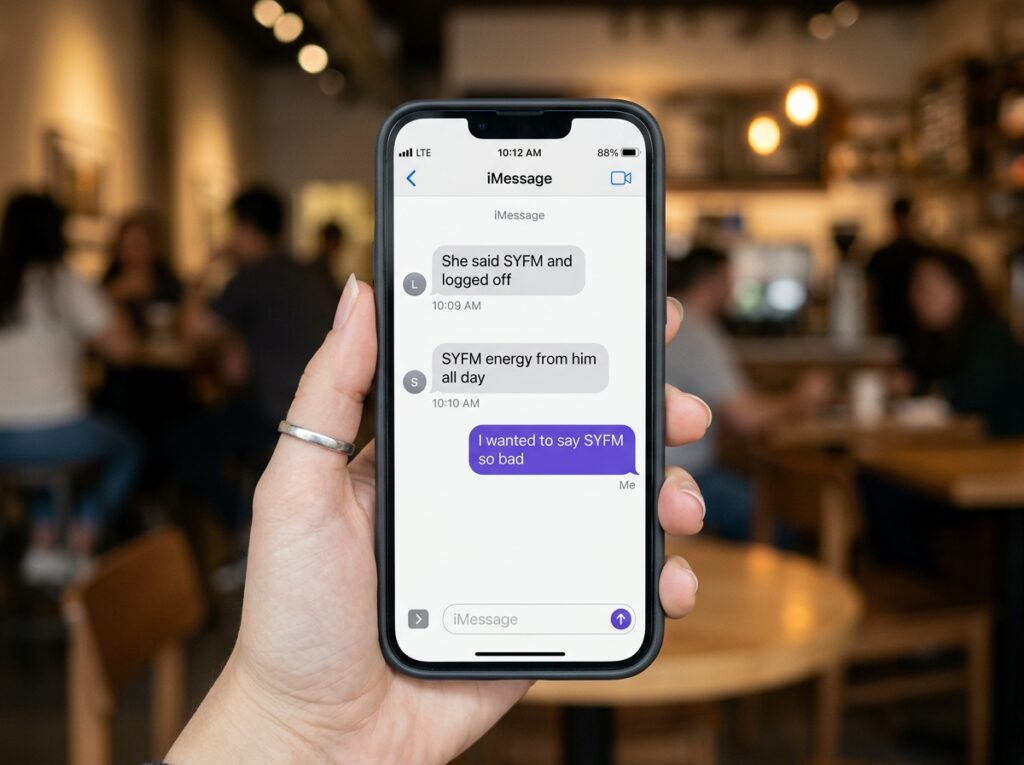
[EXAMPLE CHAT SCREENSHOT MOCKUP — fake phone chat bubbles, iMessage or WhatsApp style]
Variations and Related Slang
The most common variation is [sybau-meaning], which stands for “Shut Your B**** Ass Up.” This version is often considered even more insulting. Some people use “SYBM” as a slightly shorter alternative.
Others might just use “STFU,” which is the most famous version of this phrase. All these terms share the same goal of silencing the other person. They vary only in how rude they want to be.
| Term | Meaning | Similar/Different? |
|---|---|---|
| SYFM | Shut Your F***ing Mouth | — |
| STFU | Shut The F*** Up | Similar, but SYFM feels more personal. |
| SYBAU | Shut Your B**** Ass Up | More aggressive and targeted. |
Is “SYFM” Safe for Kids?
SYFM is not considered safe for kids. The phrase it stands for contains a “curse word.” Most parents would find the language inappropriate for younger children.
It is often used in bullying or online harassment. If you see your child using it, they might be in a heated argument. They may not even know the full phrase it represents.
Teachers and schools will definitely flag this as disrespectful behavior. It is a “red flag” term in most educational environments. Parents should explain that it is a very rude way to talk to others.
[PARENT SAFETY ICON — shield/safety graphic, 300x200px, “Parent Guide” label]
When to Use (and Avoid) “SYFM”
USE IT WHEN:
- You are joking with a best friend who has the same humor.
- Someone is being genuinely harmful or spreading dangerous lies.
- You need to end a toxic conversation fast.
AVOID IT WHEN:
- You are talking to a boss, teacher, or parent.
- You are in any kind of professional setting.
- You want to actually solve an argument calmly.
- You are speaking to someone you do not know well.
Conclusion
SYFM is a blunt tool in the world of online slang. It is designed to stop a conversation in its tracks. While it is rude, it effectively communicates high levels of frustration.
Using it shows that you have reached your limit with someone. It is a way to set a very firm, albeit aggressive, boundary. Just remember that once you send it, you can’t take back the tone.
It is a common part of how we express anger today [smh-meaning]. Use it wisely and sparingly to avoid unnecessary drama.
FAQ
FAQ #1: What does SYFM mean in a text?
SYFM stands for “Shut Your F***ing Mouth.” It is a common internet acronym used to tell someone to stop talking. It is a very aggressive and rude way to end an argument. Most people use it when they are extremely annoyed by what someone else is saying.
FAQ #2: Is SYFM a bad word?
The acronym itself is not a word, but the phrase it represents contains a swear word. Because of this, it is considered vulgar and inappropriate for formal settings. You should avoid using it with people you need to respect, like teachers or employers.
FAQ #3: Why do people use SYFM instead of STFU?
Both terms mean almost the same thing. SYFM specifically mentions the “mouth,” which can feel more personal or direct to some users. STFU is more common, so some people use SYFM to be different or emphasize their anger in a unique way.
FAQ #4: Can SYFM be used in a funny way?
Yes, close friends often use rude slang to joke with each other. If you have a playful relationship, it might just be a way of saying “stop being silly.” However, you must be sure the other person knows you are not actually angry at them.
FAQ #5: Is SYFM common on TikTok?
You will see SYFM frequently in TikTok comments and captions. It is often used to “shut down” creators who post unpopular opinions. It is also used in “POV” videos to describe how someone reacts when they are annoyed by a specific person or situation.