Your car won’t start. Your phone’s at 2%. The bus just pulled away. Then your friend texts back one word: “SOL.”
You stare at those three letters. Is it a name? A typo? Some new crypto thing?
SOL is one of those acronyms that pops up when things go wrong. Really wrong. The kind of wrong where nobody can help you anymore. It shows up in group chats when someone misses a deadline. It appears in comments when a plan falls apart completely.
This term isn’t new, but it keeps circulating online. People use it to deliver bad news quickly. Sometimes they say it with sympathy. Other times, they’re laughing at someone’s misfortune. The tone depends on context.
If you’ve seen SOL and felt confused, you’re not alone. It’s similar to how people react when they first encounter SMH in a text — pure confusion until someone explains it.
Here’s what SOL actually means and when people use it.
What Does SOL Mean?
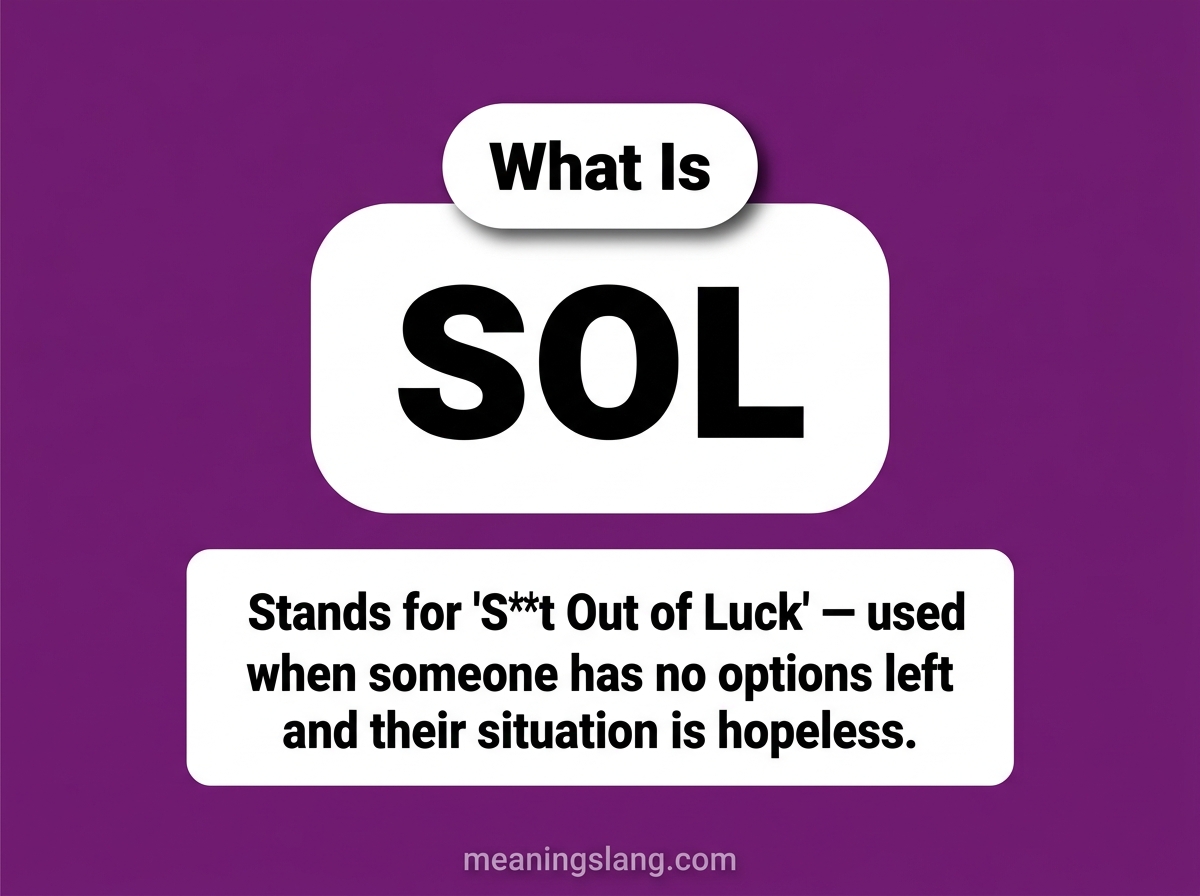
Quick Answer: SOL stands for “sh*t out of luck.” It means you’re in a hopeless situation with no solution. Nothing can fix your problem now.
SOL describes moments when you’ve lost all options. The opportunity is gone. The window closed. You had your chance, and now it’s over.
The emotional tone is usually blunt. Sometimes sympathetic. Sometimes mocking. It depends on who’s saying it and why.
When a friend says “you’re SOL,” they might be genuinely sorry. When a stranger comments it online, they’re probably finding humor in your bad situation. Context matters a lot here.
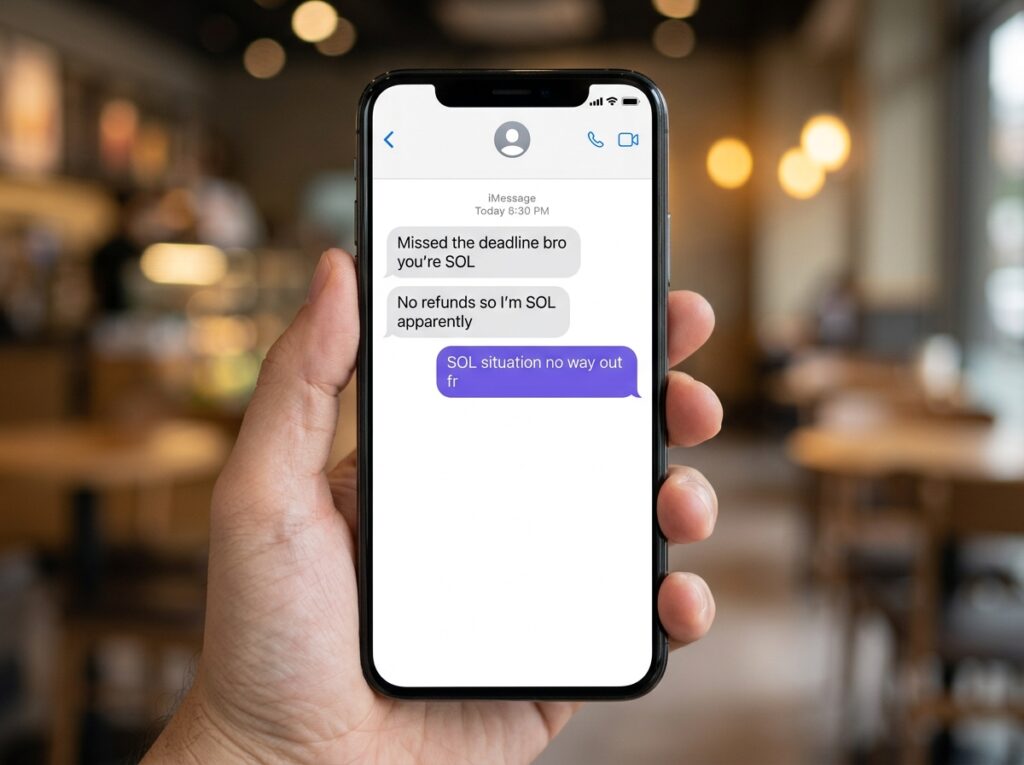
The phrase works as both a label and a reaction. Someone might describe themselves as SOL. “I forgot my wallet, so I’m SOL.” Or they might use it to respond to someone else’s problem. “Your flight got canceled? Yeah, you’re SOL.”
SOL carries a certain finality. It’s not “things look bad.” It’s “things are done.” There’s nothing left to try. You just have to accept the loss and move on.
Some people soften the acronym by saying “stuck out of luck” or “sure out of luck.” But the original meaning stays the same.
[DEFINITION GRAPHIC HERE — term on left, arrow, plain definition on right, white card background]
Origin and History of “SOL”
SOL has been around longer than the internet. Military slang from the mid-20th century used it regularly. Soldiers would say someone was SOL when supplies ran out or plans failed.
The phrase spread into everyday American English by the 1970s and 1980s. People used the full phrase first. The acronym came later, as shorthand.
When texting became popular in the 2000s, SOL found new life. Three letters were easier than typing the whole thing. It fit perfectly in quick messages.
The term never had one viral moment. It just kept showing up. Year after year, generation after generation. Unlike slang that explodes and fades, SOL quietly stuck around.
Today, younger users sometimes confuse it with Solana (the cryptocurrency). Context usually makes the meaning clear. If someone’s talking about losing money on Solana, they might actually mean both.
How “SOL” Is Used on Different Platforms
TikTok
On TikTok, SOL appears in comments when someone shares a disaster story. A video about getting scammed? Comments full of “you’re SOL now.” It’s often sympathetic but sometimes brutal.
“Just found out my ex sold my PS5… SOL I guess”
Instagram users drop SOL in DMs and story replies. It shows up when plans fall through or someone misses an event. The tone is usually casual.
“They sold out of tickets before I got there 😭 SOL”
Twitter/X
Twitter loves SOL for quick reactions to news or personal fails. It’s punchy and fits the platform’s fast pace. People use it to express frustration about situations they can’t control.
“Didn’t back up my files before my laptop died. Completely SOL.”
Snapchat
Snapchat users send SOL in chats when reacting to friends’ problems. It’s informal and often accompanied by emojis or laughing faces.
Discord/Gaming
Gamers use SOL when a match is unwinnable or loot disappears. It signals that complaining won’t help. Just accept the L.
“Server crashed before I could save. SOL.”
Reddit threads use SOL in advice posts. Someone describes a bad situation, and commenters tell them they’re SOL. It’s often the honest answer nobody wants.
| Platform | Common Use | Tone | Example |
|---|---|---|---|
| TikTok | Comment reactions | Sympathetic/harsh | “you’re SOL fr” |
| DM reactions | Casual | “SOL on those tickets 😩” | |
| Twitter/X | Quick vents | Frustrated | “Missed the deadline. SOL.” |
| Snapchat | Friend chats | Light | “lol you’re SOL” |
| Discord | Gaming chat | Matter-of-fact | “Team quit. We’re SOL.” |
| Advice threads | Blunt | “Honestly you’re SOL here.” |
SOL in Texting vs. Real Life
People type SOL far more than they say it aloud. In texts, it’s fast and efficient.
Speaking it sounds a bit awkward. Most people say the full phrase instead: “You’re sh*t out of luck.” Or they’ll just say “out of luck.”
If someone does say “SOL” out loud, they usually spell it: “S-O-L.” It sounds deliberate, almost formal. Like announcing a verdict.
The meaning doesn’t change between typing and speaking. But spoken SOL feels more dramatic. Typed SOL is just casual shorthand.
Examples of “SOL” in Sentences
GROUP 1 — Friendly/Casual
“I locked my keys in my car and AAA takes two hours. Guess I’m SOL.”
“They stopped serving breakfast at 10:30. We got here at 10:32. SOL.”
“My charger broke and every store is closed. Completely SOL tonight.”
GROUP 2 — Sarcastic/Humorous
“You trusted him with your Netflix password? Lol you’re SOL now.”
“Thought I could finish the project in one night. Turns out I’m SOL and exhausted.”
GROUP 3 — Sympathetic
“I heard your flight got canceled with no refund. Man, you’re SOL. I’m sorry.”
“The landlord won’t fix it? You might be SOL until the lease ends.”
GROUP 4 — Online/Caption Use
“When you check your bank account after vacation 💀 SOL”
“POV: you realize your crush already has a partner. SOL forever.”
[EXAMPLE CHAT SCREENSHOT MOCKUP — fake phone chat bubbles, iMessage or WhatsApp style]
Variations and Related Slang
SOL doesn’t have many spelling variations. People sometimes type it lowercase: “sol.” A few write “S.O.L.” with periods. Both mean the same thing.
Related slang carries similar energy. When someone’s SOL, they might also be described as down bad — in a rough spot emotionally or practically. The terms overlap when situations feel desperate.
Other related phrases include “taking an L” (accepting a loss) and “it’s over” (used when hope disappears). FAFO sometimes connects too — if someone caused their own SOL situation through bad choices.
| Term | Meaning | Similar/Different? |
|---|---|---|
| SOL | Sh*t out of luck | — |
| Taking an L | Accepting a loss | Similar — both acknowledge defeat |
| Down bad | In a rough situation | Similar — describes hopeless moments |
| FAFO | F*** around and find out | Related — explains why someone’s SOL |
| RIP | Rest in peace (for situations) | Similar — used when something’s dead/over |
Is “SOL” Safe for Kids?
Short answer: Not really. The “S” stands for a swear word.
SOL is a clean-looking acronym. Kids might use it without knowing the full phrase. But adults and older teens definitely know what it means.
In casual online spaces, nobody blinks at SOL. It’s mild compared to typing out swear words directly. But schools might flag it if teachers recognize the acronym.
For parents: If your kid uses SOL, it’s probably not a crisis. They might not even know the full meaning. But it’s worth a conversation about what acronyms actually stand for.
Context matters too. Using SOL about a lost video game is different from directing it at someone meanly. The word itself isn’t harmful, but the situation matters.
[PARENT SAFETY ICON — shield/safety graphic, 300x200px, “Parent Guide” label]
When to Use (and Avoid) “SOL”
USE IT WHEN:
- You’re texting close friends about a frustrating situation
- You want to quickly acknowledge that something can’t be fixed
- You’re joking about your own bad luck online
- The vibe is casual and nobody’s actually hurt
AVOID IT WHEN:
- You’re messaging coworkers, teachers, or family members
- Someone’s genuinely upset and needs support, not bluntness
- The situation involves serious loss (job, health, relationship)
- You don’t know if the other person would appreciate the language
Conclusion
SOL means you’re completely out of luck. No backup plan. No solution. The situation is what it is.
Slang like this helps people acknowledge hard truths fast. Sometimes you just need three letters to say “yeah, that’s done.” It’s honest, even if it stings.
Language keeps evolving, similar to how terms like based shifted from niche to mainstream. SOL has stayed steady for decades because the feeling it describes never goes away.
FAQ
What does SOL mean in a text?
SOL means “sh*t out of luck” in texts. Someone uses it when a situation has no solution. It signals that complaining won’t change anything. The problem is final.
Is SOL offensive?
SOL contains a hidden swear word, so it’s mildly inappropriate. Most people consider it casual, not deeply offensive. Still, avoid it in professional or formal settings.
Can SOL mean anything else?
Yes. SOL can refer to Solana, a cryptocurrency. It’s also a musical note and a Spanish word for “sun.” Context usually makes the meaning obvious.
Is SOL the same as “taking an L”?
They’re similar but different. Taking an L means accepting a specific loss. SOL means you’re completely out of options. SOL feels more final and hopeless.
Why do people use SOL instead of just saying it?
The acronym is faster to type and looks cleaner. It softens the swear word slightly while keeping the meaning clear. Plus, it’s been slang for decades.