Your coworker just texted the group chat: “WFH today, call me if you need anything.”
You stare at those three letters. Is it a company code? A new project name? Some kind of inside joke you missed?
Here’s the thing. WFH became one of the most typed acronyms in the world almost overnight. Before 2020, it floated around corporate emails. Then suddenly, everyone from your boss to your cousin started using it daily.
This little abbreviation shows up everywhere now. Slack messages. Instagram captions. Out-of-office replies. Even casual texts between friends making plans.
The confusion makes sense. Three-letter acronyms pop up constantly online, much like what SMH means when someone expresses frustration. WFH follows the same quick-communication pattern.
But WFH carries its own specific meaning and vibe. It signals something about how you spend your day. And depending on who’s saying it, the tone can range from professional to playful to slightly apologetic.
Let’s break down exactly what WFH means and how people actually use it.
What Does WFH Mean?
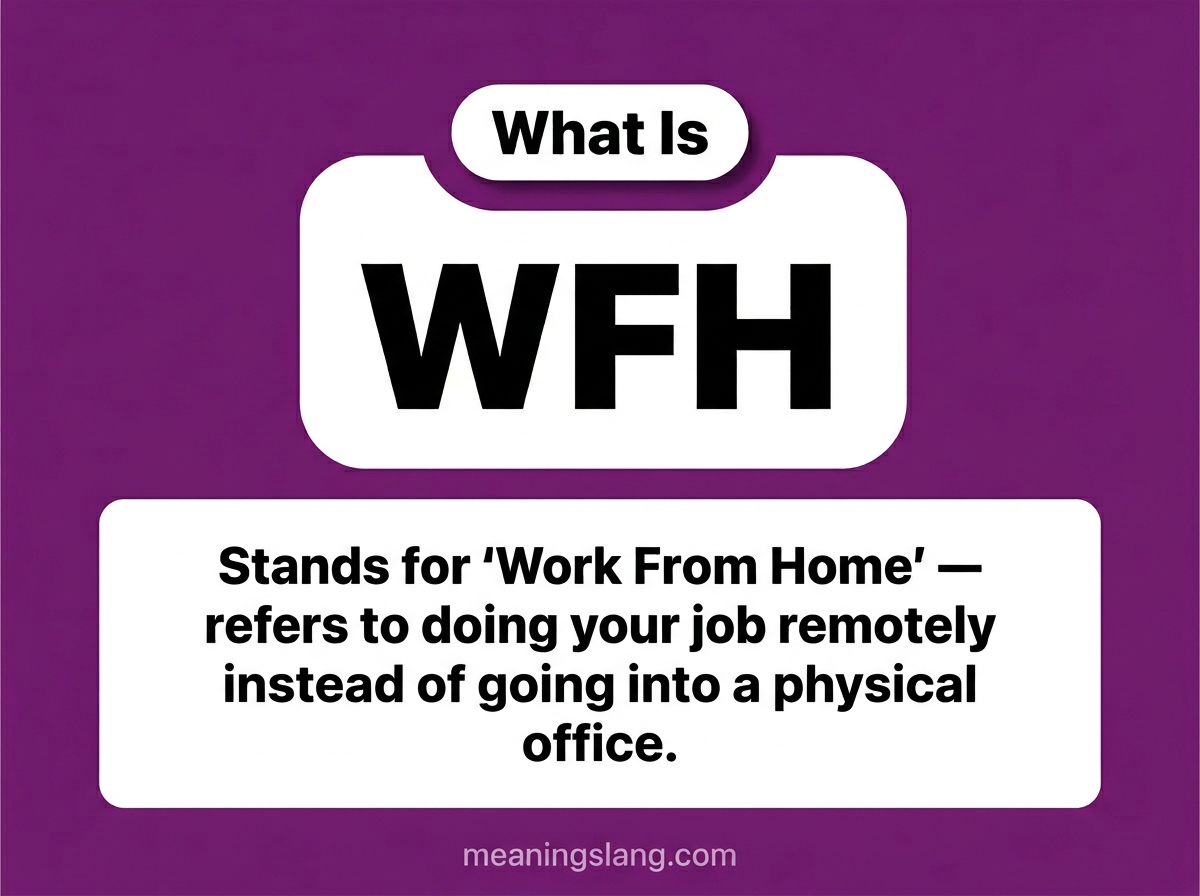
QUICK ANSWER: WFH stands for “work from home.” It means someone is doing their job from their house instead of going to an office. People use it in texts, emails, and social media to quickly explain their work situation.
The full meaning is simple. WFH tells others you’re working remotely that day or in general. It started as workplace shorthand but spread into everyday conversation.
The emotional tone shifts based on context. In a work email, “I’m WFH today” sounds professional and neutral. In a text to friends, “Can’t make lunch, WFH” might carry a hint of disappointment. On social media, a WFH post often has a cozy or humble-brag energy.
When your manager says it, WFH feels like a schedule update. When your friend says “I’ve been WFH for two years now,” it sounds more like a lifestyle statement.
Here’s how it shows up naturally. Someone might text “WFH tomorrow so I can let the repair guy in.” Or they might caption a photo of their laptop on a couch with just “WFH vibes.” The term adapts to fit the situation without needing extra explanation.
The meaning stays consistent across contexts. Working from home. That’s it. But the feeling around those words changes based on who’s typing them and why.
Origin and History of “WFH”
WFH didn’t come from TikTok or gaming. It grew out of corporate email culture in the early 2000s.
Office workers started abbreviating common phrases to save time in emails. WFH joined a family of workplace acronyms like OOO (out of office), EOD (end of day), and PTO (paid time off). It lived quietly in HR communications and team updates.
Then 2020 happened. The pandemic forced millions of people to work remotely overnight. Suddenly WFH went from niche office jargon to universal vocabulary.
News outlets used it in headlines. Social media filled with WFH memes. People who’d never sent a work email started using the term casually.
The meaning never changed. But the cultural weight did. WFH stopped being just a schedule note. It became a symbol of a massive shift in how people live and work.
By 2023, WFH had settled into permanent slang status. Even as offices reopened, the acronym stuck around. It now represents an entire category of work life that millions of people experience daily.
How “WFH” Is Used on Different Platforms
TikTok
WFH content dominates productivity and lifestyle corners of TikTok. Creators share “WFH morning routines” or joke about WFH struggles like never leaving pajamas. The tone is usually relatable and slightly self-deprecating.
“POV: You’ve been WFH for three years and forgot how to make small talk.”
Instagram uses WFH in two main ways. Aesthetic desk setups get the hashtag treatment. Stories use it as a quick status update for friends. Captions range from cozy to aspirational.
“Monday WFH setup. Coffee’s doing all the work today.”
Twitter/X
Twitter treats WFH as both serious and comedic. Professionals discuss WFH policies. Everyone else jokes about WFH chaos. Hot takes about remote work regularly trend.
“WFH sounded great until I realized my cat thinks he’s my manager.”
Slack and Work Chats
This is WFH’s natural habitat. Quick status updates. Calendar notes. Team announcements. The tone stays professional but efficient.
“WFH today — available on Slack all day.”
Discord and Gaming
Gamers use WFH to explain why they’re online during work hours. It signals “I’m technically working but also available.” The tone is casual and often conspiratorial.
“WFH so I can hop on for a few matches at lunch.”
| Platform | Common Use | Tone | Example |
|---|---|---|---|
| TikTok | Lifestyle content, routines | Relatable, humorous | “WFH day 847: forgot what pants feel like” |
| Desk photos, status updates | Aesthetic, casual | “WFH with a view today” | |
| Twitter/X | Hot takes, jokes, discussions | Varied, often sarcastic | “WFH saved me $200/month in gas” |
| Slack | Schedule updates | Professional, brief | “WFH — ping me anytime” |
| Discord | Availability status | Casual, playful | “WFH so I’m around all afternoon” |
WFH in Texting vs. Real Life
In texts and emails, WFH flows naturally. It saves time. Everyone understands it instantly.
Spoken out loud? It gets a little awkward. Most people say the full phrase “working from home” instead of pronouncing “W-F-H” as three letters.
You might hear someone say “I’m W-F-H today” in a quick conversation. But it sounds slightly robotic compared to texting it. The written version feels natural. The spoken version feels like you’re reading an acronym off a screen.
When you say “working from home,” you can add tone and emotion. The abbreviation loses that warmth. That’s why WFH stays mostly typed rather than spoken in everyday conversations.
Examples of “WFH” in Sentences
GROUP 1 — Friendly/Casual
“I’m WFH tomorrow so let’s grab coffee in the afternoon.”
“Been WFH all week and my house has never been cleaner.”
“WFH day means I finally have time to cook a real lunch.”
GROUP 2 — Professional/Work Context
“The whole team is WFH on Fridays now.”
“I’ll be WFH but available for the 2pm call.”
GROUP 3 — Sarcastic/Humorous
“WFH = wearing the same hoodie for the fifth day straight.”
“My commute is WFH and it still takes 20 minutes to get motivated.”
GROUP 4 — Online/Caption Use
“WFH setup complete. Now I just need motivation.”
“Monday WFH mood: camera off, snacks on.”
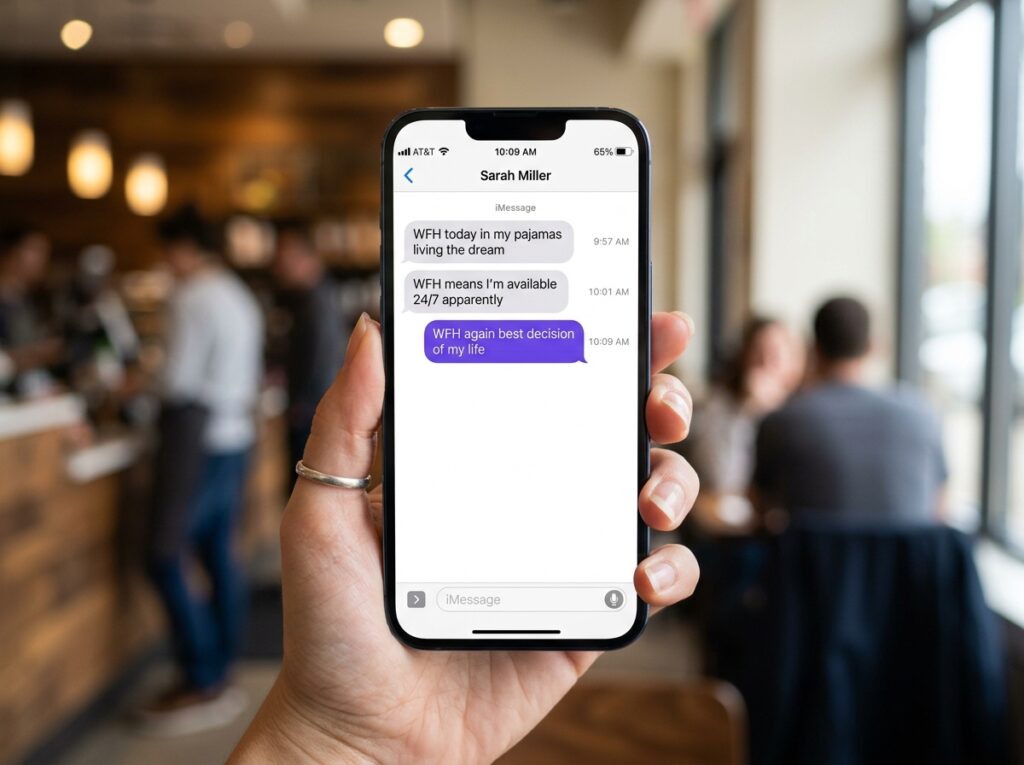
[EXAMPLE CHAT SCREENSHOT MOCKUP — fake phone chat bubbles, iMessage or WhatsApp style]
Variations and Related Slang
WFH has a few cousins in the remote work vocabulary world.
Remote works as a standalone adjective. “I’m remote” means the same thing but sounds slightly more permanent than WFH.
Hybrid refers to splitting time between home and office. Someone might say “I’m hybrid, WFH Mondays and Fridays.”
OOO means out of office entirely — vacation, sick day, or personal time. Different from WFH because you’re not working at all.
Distributed describes teams spread across locations. It’s more corporate but related to the WFH concept.
These terms overlap with how people share quick status updates, similar to how IMO signals an opinion in casual messages.
| Term | Meaning | Similar/Different? |
|---|---|---|
| WFH | Working from home | — |
| Remote | Working outside an office permanently | More permanent than WFH |
| Hybrid | Mix of office and home work | Includes some WFH days |
| OOO | Out of office, not working | Not working at all |
| WFA | Work from anywhere | Broader than just home |
Is “WFH” Safe for Kids?
Yes. WFH is completely safe for kids to use and see.
There’s nothing offensive, edgy, or hidden in this acronym. It literally just means working from home. No alternate meanings exist in slang communities.
Kids might hear parents say it constantly. They might see it in texts or on social media. There’s zero reason for concern about this particular term.
If your child starts using WFH, they probably just absorbed it from hearing adults. It shows they’re paying attention to how people communicate efficiently.
Teachers and schools would have no issue with students using WFH. It’s professional vocabulary, not slang that pushes boundaries. This one’s genuinely worry-free.
[PARENT SAFETY ICON — shield/safety graphic, 300x200px, “Parent Guide” label]
When to Use (and Avoid) “WFH”
USE IT WHEN:
- Updating your team about your work location
- Texting friends to explain your schedule
- Posting about your remote work setup on social media
- Setting your status on Slack or similar platforms
AVOID IT WHEN:
- Talking to someone unfamiliar with work culture (elderly relatives, young kids)
- Writing formal documents that need full phrases
- Speaking out loud in conversations where it sounds forced
- Communicating with international contacts who might not know the acronym
Conclusion
WFH means working from home. Three letters that capture an entire shift in how millions of people spend their workdays.
This acronym shows how language adapts to life changes. When remote work exploded, we needed a fast way to communicate it. WFH filled that gap perfectly.
It’s professional enough for your boss. Casual enough for your group chat. Universal enough that almost everyone recognizes it now.
Slang like this reflects real human needs — the need to explain ourselves quickly and clearly. Much like how OFC became shorthand for obvious agreement, WFH became shorthand for a lifestyle.
Next time you type those three letters, you’re part of that ongoing language evolution.
FAQ
What does WFH mean in a text message?
WFH means “work from home” in texts. Someone is telling you they’re doing their job from their house that day. It’s a quick way to share their schedule without typing the full phrase.
Is WFH the same as remote work?
They’re similar but slightly different. WFH usually means working from home on specific days. Remote work often implies a permanent arrangement where someone never goes to a physical office.
Can I use WFH in professional emails?
Yes, WFH is acceptable in most workplace communication. It’s commonly used in team chats, calendar updates, and internal emails. For very formal external communication, spell out the full phrase instead.
Why do people say WFH instead of just “home”?
WFH specifies that you’re working, not just hanging out at home. Saying “I’m home” could mean anything. “I’m WFH” clearly communicates that you’re available for work tasks.
When did WFH become popular?
WFH existed in office culture for years but exploded in 2020 during the pandemic. When millions started working remotely overnight, the acronym became universal vocabulary across all platforms.