Your manager just sent a message: “What’s the ETA on that report?”
You stare at it. You know ETA usually means “estimated time of arrival.” But there’s no plane. No package. Just you and a spreadsheet.
Business speak borrows a lot of terms from travel and shipping. ETA is one of the most common. It pops up in Slack messages, project updates, and emails from people who could just ask “when will it be done?”
The good news? ETA in business means almost the same thing as ETA everywhere else. It’s asking when something will be finished or delivered. But there are small differences in how it’s used at work.
People also use plenty of other abbreviations in professional settings. You might see terms like what WFH means or wonder about other short forms in your inbox.
This term feels formal but it’s actually pretty casual. Once you get it, you’ll spot it everywhere. And you’ll never freeze when your boss asks for one again.
What Does ETA Mean in Business?
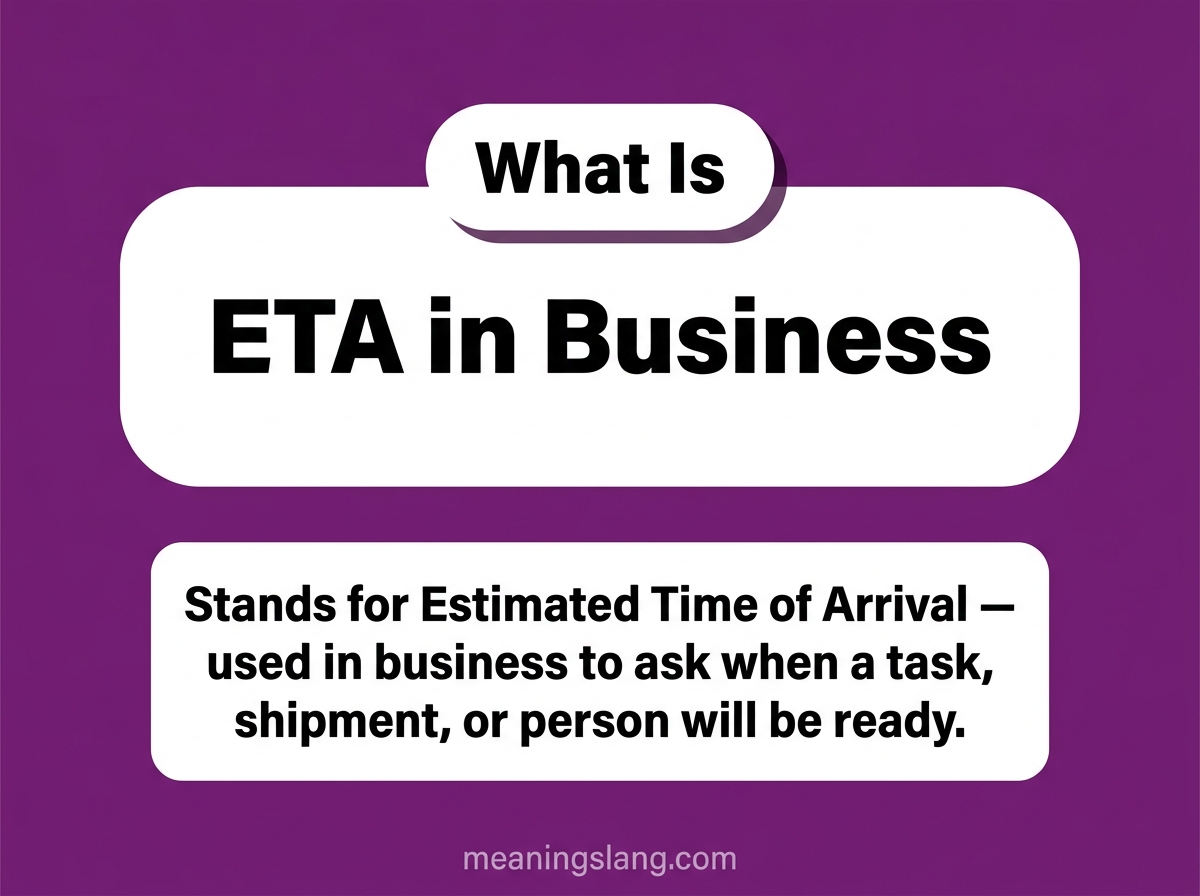
QUICK ANSWER: ETA stands for “Estimated Time of Arrival.” In business, it means the expected time or date when a task, project, or deliverable will be finished. When someone asks for your ETA, they want to know when you’ll be done.
The core meaning stays the same across contexts. In shipping, ETA tells you when a package arrives. In business, it tells you when work arrives.
When your coworker asks “What’s the ETA?” they’re saying “give me a realistic deadline.” It’s not about exact times down to the minute. It’s about setting expectations.
The tone is usually neutral and professional. There’s no hidden judgment. A manager asking for an ETA just wants to plan around your timeline. You might reply “ETA is Friday afternoon” or “I should have it by end of day.”
Sometimes ETA carries a slight urgency. If someone asks twice, they probably need it soon. But the word itself isn’t pushy — it’s just practical.
You’ll hear ETA in meetings too. “What’s the ETA on the new website?” means “when can we expect it to launch?” The term works for any deliverable: reports, designs, code, decisions, or responses.
[DEFINITION GRAPHIC HERE — term on left, arrow, plain definition on right, white card background]
Origin and History of “ETA”
ETA started in transportation. Ships, planes, and trains all use estimated arrival times. The abbreviation made communication faster between ports and airports.
By the mid-1900s, ETA was standard in logistics. Shipping companies printed it on tracking documents. Airlines used it for flight schedules. The military adopted it too.
Business borrowed ETA because offices needed the same concept. Projects have destinations, just like planes do. The “arrival” is when the work lands on someone’s desk.
The shift happened naturally. As workplaces became faster, short terms spread. Email made abbreviations even more popular. Nobody wants to type “estimated time of arrival” in every message.
Today ETA fits everywhere. Startups use it. Big corporations use it. Even your group chat probably uses it when someone’s running late. The business meaning grew from the original — it just replaced “location” with “completion.”
How “ETA” Is Used on Different Platforms
Slack and Microsoft Teams
ETA lives in workplace chat apps. A quick “ETA?” in a thread means someone needs a timeline. The reply is usually casual: “ETA 3pm” or “Should be done by tomorrow.”
Example: “Hey, what’s the ETA on those mockups?”
In emails, ETA sounds a bit more formal. People often write it out fully or explain what they need. It usually appears in project updates or check-in messages.
Example: “Could you provide an ETA for the client presentation?”
Project Management Tools
Platforms like Asana, Trello, or Monday use ETA constantly. Task comments often ask for updated ETAs when deadlines slip. This keeps everyone aligned.
Example: “The original ETA was Monday — any update?”
Text Messages
In work texts, ETA stays short and punchy. It often comes without full sentences. Context makes the meaning clear.
Example: “ETA on the budget numbers?”
You won’t see ETA in posts much. But recruiters use it in DMs when coordinating interviews or responses.
Example: “What’s your ETA for a decision on the offer?”
| Platform | Common Use | Tone | Example |
|---|---|---|---|
| Slack | Quick check-ins | Casual | “ETA on that fix?” |
| Formal requests | Professional | “Please share an ETA when possible” | |
| Project tools | Status updates | Neutral | “Need an updated ETA” |
| Text | Fast coordination | Direct | “ETA?” |
| Recruiting/scheduling | Polite | “ETA for your availability?” |
ETA in Texting vs. Real Life
In texts and chats, ETA is super common. You’ll type it dozens of times a week at work.
People say it out loud too. In meetings, you might hear “What’s our ETA on that?” It doesn’t sound weird when spoken.
The meaning stays identical. Written or spoken, ETA asks for a time estimate. No confusion there.
The main difference is formality. In speech, people sometimes say the full phrase instead. “What’s the estimated arrival time?” sounds natural in a meeting. But “ETA” works just as well.
Younger workers tend to say the abbreviation more. It’s quicker and everyone knows it.
Examples of “ETA” in Sentences
GROUP 1 — Friendly/Casual
“Any ETA on when you’ll finish reviewing my doc?”
“ETA is probably Thursday — I’m still waiting on data from sales.”
“Just checking in for an ETA on the logo designs!”
GROUP 2 — Professional/Work Settings
“Could you share an ETA with the stakeholders by end of day?”
“The client is asking for an ETA on phase two delivery.”
GROUP 3 — Sarcastic/Humorous
“Been waiting three weeks. What’s the ETA — next century?”
“ETA: somewhere between now and never, knowing how this project goes.”
GROUP 4 — Online/Chat Use
“Updated ETA: Monday AM, sorry for the delay”
“ETA on the meeting notes? I need them before the call”
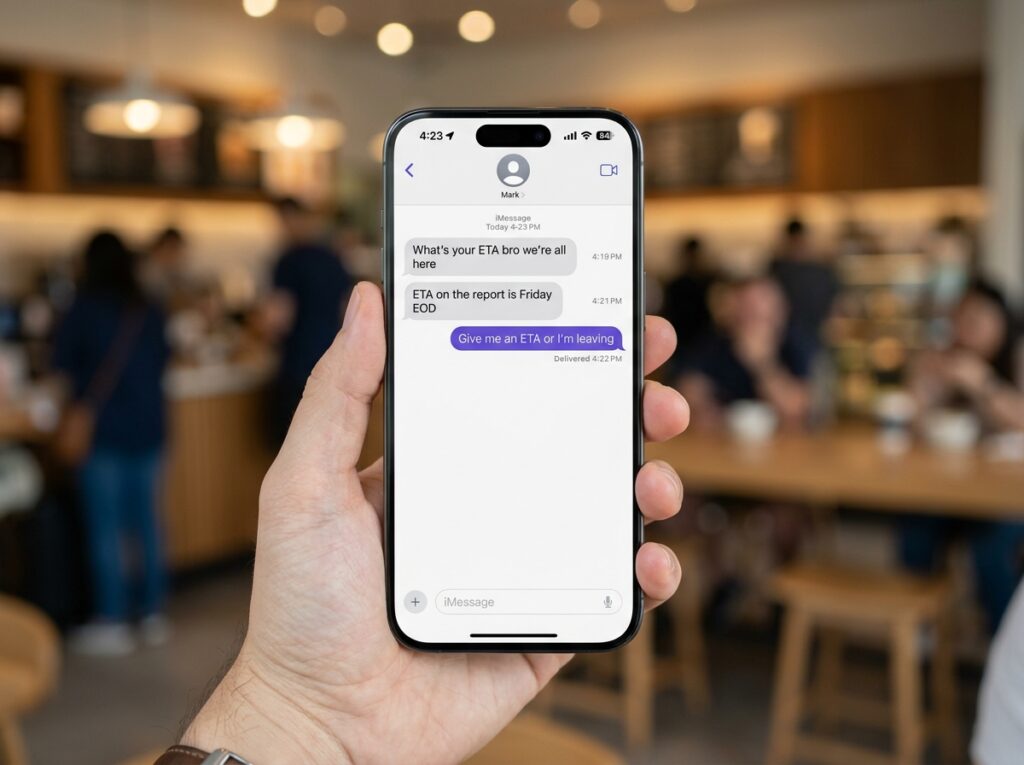
[EXAMPLE CHAT SCREENSHOT MOCKUP — fake phone chat bubbles, iMessage or WhatsApp style]
Variations and Related Slang
ETA doesn’t have many spelling variations. You’ll see it as:
- ETA (most common, all caps)
- eta (lowercase in casual chats)
- E.T.A. (older style with periods, rare now)
Related business slang includes several other short forms. Understanding abbreviations like what IMO means helps you decode work conversations faster.
Other terms in the same space:
- EOD — End of Day (when something is due)
- COB — Close of Business (similar to EOD)
- ASAP — As Soon As Possible (urgent request)
- TBD — To Be Determined (no set time yet)
- WIP — Work in Progress (not finished)
| Term | Meaning | Similar/Different? |
|---|---|---|
| ETA | Estimated completion time | — |
| EOD | End of day deadline | Different — exact deadline, not estimate |
| ASAP | Do it immediately | Different — urgency, not timeline |
| TBD | Not decided yet | Different — no estimate given |
| WIP | Currently being worked on | Related — status, not time |
Is “ETA” Safe for Kids?
Yes, ETA is completely safe. There’s nothing offensive or inappropriate about it.
The term is neutral business language. It has no hidden meanings or slang variations that could be problematic.
Kids might not hear ETA often unless their parents work from home. But it’s harmless if they pick it up. They might start asking “What’s the ETA on dinner?” which is honestly just efficient communication.
Schools wouldn’t flag this term at all. Teachers might even use it themselves when discussing assignment deadlines.
Parents don’t need to worry about this one. It’s just a practical abbreviation with no baggage.
[PARENT SAFETY ICON — shield/safety graphic, 300x200px, “Parent Guide” label]
When to Use (and Avoid) “ETA”
USE IT WHEN:
- You need a timeline for a project or task
- Someone asks when you’ll finish something
- You’re giving a status update to your team
- You want to sound professional but not stiff
AVOID IT WHEN:
- The situation needs a firm deadline, not an estimate
- You’re talking to someone unfamiliar with business terms
- The request sounds impatient already (adding “ETA” might feel pushy)
- You’re outside of work contexts where it might seem overly formal
Conclusion
ETA means “estimated time of arrival” — even when nothing’s physically arriving. In business, it’s asking when something will be done.
This abbreviation shows how workplace language borrows from other fields. We took a shipping term and made it work for spreadsheets and presentations. Language adapts because people need shortcuts.
Slang and abbreviations connect us at work just like they do online. You might see what OFC means in a casual work chat and realize the same rules apply. Keep it clear, keep it simple, and you’ll communicate just fine.
FAQ
What does ETA mean when a boss asks for it?
Your boss wants to know when you’ll finish the task. Give them a realistic date or time. Don’t overpromise — an honest estimate works better than an impossible deadline you’ll miss.
Is ETA only used in business settings?
No. ETA appears in texting, travel, shipping, and casual conversations too. It started in transportation but now works anywhere you need a time estimate for anything arriving or finishing.
How do you respond when someone asks for an ETA?
Give a specific time or date range. Say something like “ETA is Friday afternoon” or “I’m aiming for end of day tomorrow.” If you’re unsure, say so and offer to update them soon.
What’s the difference between ETA and a deadline?
ETA is an estimate — your best guess. A deadline is a fixed requirement. You might have a Friday deadline but your ETA is Wednesday. One is flexible, the other isn’t.
Can ETA be rude to ask for?
Usually no. It’s a neutral question. But asking repeatedly or in an impatient tone can feel pushy. Context matters. A simple “Any ETA?” is fine. Adding “ETA???” with multiple question marks feels aggressive.