Your friend shares their new favorite song. You listen. You reply: “It’s good!” They hit back with one brutal word: “Nah, it’s mid.”
Wait. What just happened?
You’ve seen “mid” everywhere lately. TikTok comments. Gaming chats. Reviews of movies, food, and even people’s outfits. Everyone seems to agree that mid is bad. But why? It sounds like “middle.” How is average an insult now?
Here’s the thing. Calling something mid hurts more than calling it bad. Bad things can still be interesting. Bad things spark debate. Mid? Mid means you’re not even worth arguing about. You’re just… there. Forgettable. Room temperature water in human form.
This slang hit different because it attacks effort, not just quality. You tried, and you still landed in the middle. That stings.
If you’ve been seeing mid pop up and feeling lost, you’re catching up at the right time. This word isn’t going anywhere. It’s become one of Gen Z’s sharpest tools for casual judgment, right up there with calling someone an NPC. Let’s break down what it actually means and how people use it.
What Does Mid Mean?
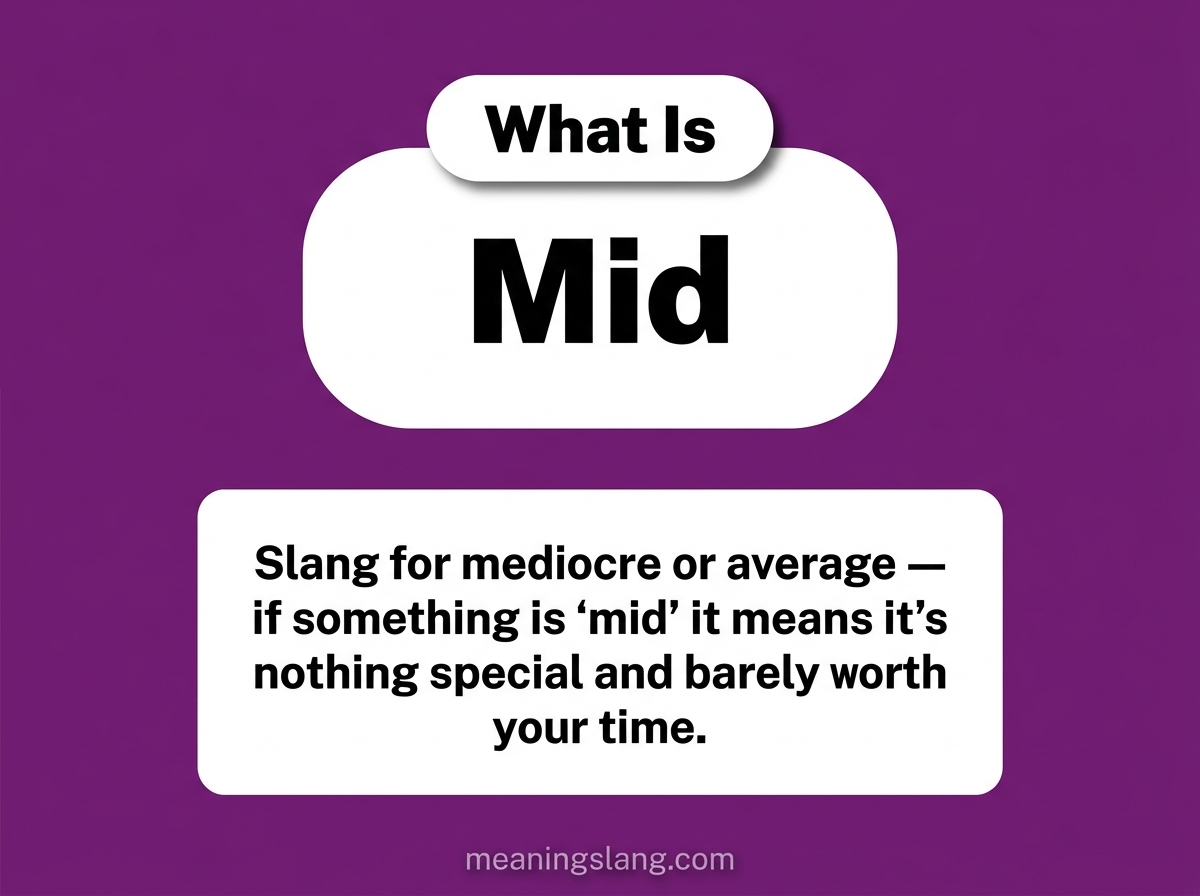
Quick Answer: Mid means something is average, mediocre, or just not impressive. It’s used as an insult to say something or someone is underwhelming and forgettable. Think “not bad, but definitely not good either.”
When someone calls something mid, they’re saying it failed to impress. It didn’t bomb. It didn’t shine. It just existed in the most forgettable way possible.
The emotional weight here matters. Mid isn’t neutral. It carries disappointment. You expected something special and got plain toast instead.
Context changes the sting level. Friends joking about a mid meal? Light teasing. Someone calling your creative project mid? That cuts deep. The word works because it sounds casual while delivering real criticism.
You’ll hear people say things like “That movie was so mid” after a hyped release flops. Or “His fit is mid” about an outfit that tried too hard. The judgment feels objective even when it’s totally subjective.
Mid can describe anything: food, music, shows, games, opinions, people’s takes, even entire cities. If it exists and someone finds it underwhelming, they can call it mid.
The tone usually stays matter-of-fact. People don’t yell “MID!” like an insult. They state it calmly, which makes it sting more. It’s the verbal equivalent of a shrug after someone pours their heart into something.
Origin and History of “Mid”
Mid didn’t start on TikTok. The word has roots in hip-hop and cannabis culture from the early 2000s.
In weed communities, “mid” or “mids” meant average-quality marijuana. Not the cheap stuff. Not the premium either. Just okay. Serviceable. Nothing to brag about.
Hip-hop picked this up. Rappers started calling rivals “mid” to question their skills without bothering to fully insult them. Saying someone was mid dismissed them entirely. You’re not even worth real criticism.
The word stayed underground for years. Then TikTok happened.
Around 2021-2022, mid exploded online. A viral clip of someone yelling “It’s called the Midwest because everything about it is MID!” helped push it mainstream. Gaming communities, particularly fighting game fans, had already been using mid to rank characters and players.
By 2023, mid had become standard Gen Z vocabulary. The meaning stayed consistent: average, disappointing, not living up to expectations. It crossed from niche internet circles to everyday group chats.
Now in 2026, mid remains one of the most common casual insults online. Its power comes from how unbothered it sounds.
How “Mid” Is Used on Different Platforms
TikTok
Mid dominates TikTok comments. When a hyped product review disappoints, comments flood with “this is so mid.” Creators use it in videos ranking things from “fire” to “mid” to “trash.” It’s become a rating system. “Mid tier” sits right below anything worth recommending.
“Waited 3 weeks for this palette and it’s lowkey mid”
On Instagram, mid appears in story reactions and DM replies. Someone posts their outfit and their friend replies with just “mid” followed by a skull emoji. It’s also common in caption debates when people disagree about whether something deserves the hype.
“Everyone saying this restaurant is amazing but the food was mid ngl”
Twitter/X
Twitter users weaponize mid in takes and quote tweets. Calling someone’s opinion “mid take” dismisses it without engaging. Sports fans love calling players “mid” after bad games. Movie discourse especially attracts mid discourse.
“$200 million budget and the CGI is mid, I’m crying”
Discord/Gaming Chats
Gamers use mid constantly. Characters, builds, weapons, player skills—everything gets rated. “He’s mid at best” about a player. “That gun is mid this season” about a nerfed weapon. It’s shorthand for not competitive enough.
“Stop picking mid characters and wondering why you’re losing”
Reddit discussions use mid in reviews and recommendations. Someone asks for show suggestions, and replies include “Season 1 is great but Season 2 is mid.” It signals you can skip something without calling it unwatchable.
“Honestly the gameplay loop is mid but the story carries”
| Platform | Common Use | Tone | Example |
|---|---|---|---|
| TikTok | Comment ratings | Dismissive | “This trend is mid already” |
| DM reactions | Playful/teasing | “Your fit today? Mid sorry” | |
| Twitter/X | Hot takes | Snarky | “Mid album, mid era” |
| Discord | Gaming rankings | Analytical | “That weapon is mid tier” |
| Reviews | Matter-of-fact | “Graphics are mid for 2026” |
Mid in Texting vs. Real Life
People definitely say mid out loud now. It’s crossed over from typing to speaking.
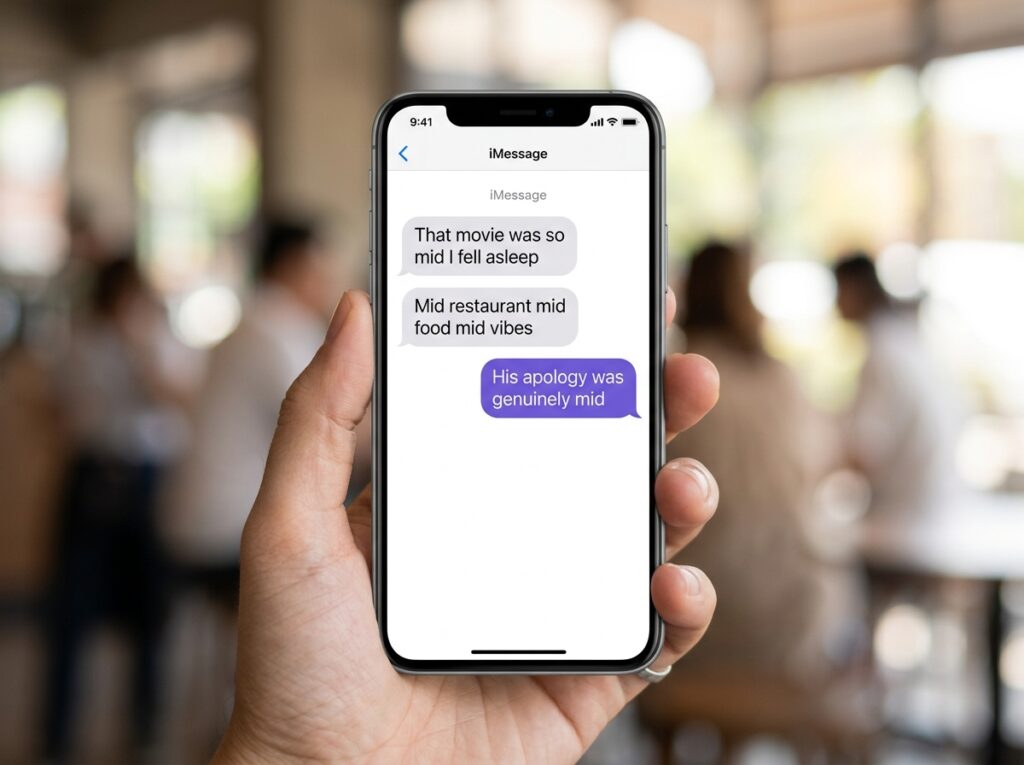
In texts, mid often stands alone. Someone sends you a song. You reply: “mid.” That single word carries the whole review.
Spoken aloud, it sounds more casual. “Yeah, the party was mid” works naturally in conversation. The word is short enough to not feel awkward when spoken.
However, typed mid hits harder. When someone takes time to type just that one word, the dismissiveness lands differently. In person, tone and facial expression soften it. Online, mid sits there cold and final.
You’ll hear mid most often among younger speakers. People over 30 might still find it strange out loud. But in Gen Z and Gen Alpha circles, saying “that’s mid” flows as naturally as saying “that’s whatever.” Similar to how people started saying SMH out loud eventually.
Examples of “Mid” in Sentences
GROUP 1 — Friendly/Casual
“The new season dropped and honestly it’s kinda mid.”
“We tried that burger place everyone hypes and it was mid at best.”
“His take on the situation was mid, I expected better from him.”
GROUP 2 — Sarcastic/Humorous
“You really spent $500 on mid? Couldn’t be me.”
“Mid vacation but at least the WiFi worked I guess.”
GROUP 3 — Critical/Direct
“Stop defending mid games just because they’re from your favorite studio.”
“That album release was mid and everyone pretending otherwise is lying.”
GROUP 4 — Online/Caption Use
“Rating everything I ate today: breakfast was fire, lunch was mid, dinner was a mistake”
“When the fit check is mid but you post it anyway 📸”
“Product review: 5/10, solidly mid, save your money”
[EXAMPLE CHAT SCREENSHOT MOCKUP — fake phone chat bubbles, iMessage or WhatsApp style]
Variations and Related Slang
Mid stays pretty consistent in spelling. You might see “midd” occasionally for emphasis, but that’s rare. The word works best short.
Some people extend it to “mid asf” (mid as f*ck) for extra emphasis. Others pair it with “lowkey” as in “lowkey mid” to soften the criticism slightly.
Related terms cover similar territory. If someone is down bad about something mid, they’re way too invested in something average. When things cross from mid into embarrassing, people might call the situation sus.
There’s also “fire” and “trash” on opposite ends. Fire means excellent, trash means terrible, mid sits uncomfortably between them.
“Basic” overlaps with mid but implies trying too hard to fit in. Mid suggests you tried and missed. Basic suggests you didn’t try to be original.
| Term | Meaning | Similar/Different? |
|---|---|---|
| Mid | Average, underwhelming | — |
| Basic | Unoriginal, mainstream | More about conformity than quality |
| Trash | Terrible, bad | Worse than mid |
| Fire | Excellent, impressive | Opposite of mid |
| Peak | The best version | Far above mid |
| Solid | Good but not amazing | Slightly above mid |
| Meh | Indifferent | Similar energy, less trendy |
Is “Mid” Safe for Kids?
Yes, mid is safe. It contains no profanity or explicit meaning.
That said, context matters. Mid is still an insult. Kids using it to put down classmates’ work or appearance can cause hurt feelings. The word sounds mild but carries real dismissiveness.
Parents should know that kids calling things mid is normal slang usage. Calling a movie mid? Harmless opinion. Calling someone’s art project mid? That’s unkind.
Schools probably wouldn’t flag this word specifically. It’s not vulgar. But teachers might address it if students use it to tear down peers’ efforts.
If your child is using mid constantly, it might reflect broader critical or dismissive attitudes worth discussing. The word itself isn’t the problem. How it’s aimed at people versus things matters more.
[PARENT SAFETY ICON — shield/safety graphic, 300x200px, “Parent Guide” label]
When to Use (and Avoid) “Mid”
USE IT WHEN:
- Giving honest opinions about media, food, or products among friends
- Joking with close friends who understand your humor
- Rating things casually in low-stakes conversations
- Participating in online discussions where direct opinions are expected
AVOID IT WHEN:
- Someone shares creative work they’re proud of
- You’re talking to someone you don’t know well
- The setting is professional or formal
- You’re trying to be constructive rather than dismissive
Conclusion
Mid means something is average, forgettable, and not worth the hype. It’s Gen Z’s favorite way to express disappointment without yelling about it.
This slang sticks around because it captures a specific feeling. Not anger. Not hate. Just… “that’s it?” Disappointment dressed in casual clothes.
Language like mid shows how each generation creates new tools for old emotions. We’ve always felt underwhelmed. Now there’s a single syllable that says it perfectly.
Understanding slang like sigma or mid helps you decode how younger generations communicate their judgments quickly and efficiently.
FAQ
What does mid mean when someone says it about a person?
When directed at a person, mid means they’re average-looking, have unremarkable skills, or lack standout qualities. It’s dismissive rather than hateful. The implication is they’re forgettable, which some find more insulting than being called outright bad.
Is calling something mid an insult?
Yes, mid functions as a soft insult. It criticizes without aggression. Saying something is mid dismisses effort and hype around it. While not harsh, it clearly communicates disappointment and lack of impression.
Where did the slang mid come from originally?
Mid originated in cannabis culture to describe average-quality weed. Hip-hop artists adopted it to dismiss rivals’ skills. It went mainstream through TikTok and gaming communities around 2021-2022 and remains widely used.
Can mid be used positively?
Rarely. Some people use “not mid” as a compliment, meaning something exceeded expectations. But mid itself always indicates disappointment. There’s no positive spin on calling something average and underwhelming.
What’s the opposite of mid in slang?
The opposite is “fire” or “peak.” Fire means something is excellent and impressive. Peak means it’s the best possible version. Both indicate something far exceeded expectations, the exact opposite of landing in forgettable middle territory.