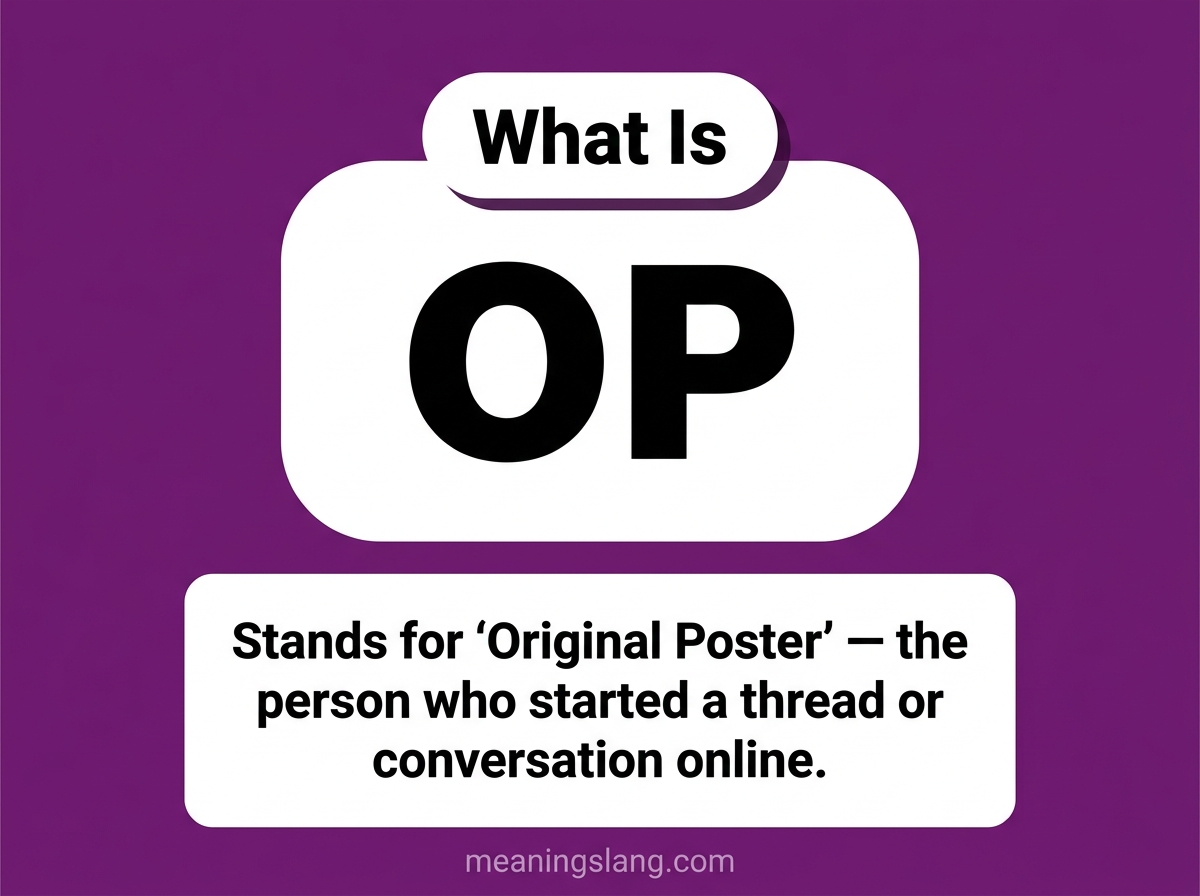
Someone in a Reddit thread just typed “OP is wrong about this.” You stare at it. Who is OP? Is that a username? An insult? Some internet code you missed?
Then you hop into a gaming chat. Your teammate shouts, “That weapon is so OP, nerf it!” Same two letters. Totally different energy.
This is the weird thing about OP. It means two completely different things depending on where you see it. On forums and social media, it’s about a person. In gaming and memes, it’s about power.
The confusion makes sense. Both meanings are everywhere online. Both get used constantly. And nobody stops to explain which one they mean.
If you’ve seen OP in a comment section, a Discord server, or a text from your gamer friend, you’re probably here because context alone didn’t cut it. Similar to how SMH expresses frustration, OP packs a lot of meaning into just two letters.
Here’s everything you need to know about this double-duty slang term.
What Does OP Mean?
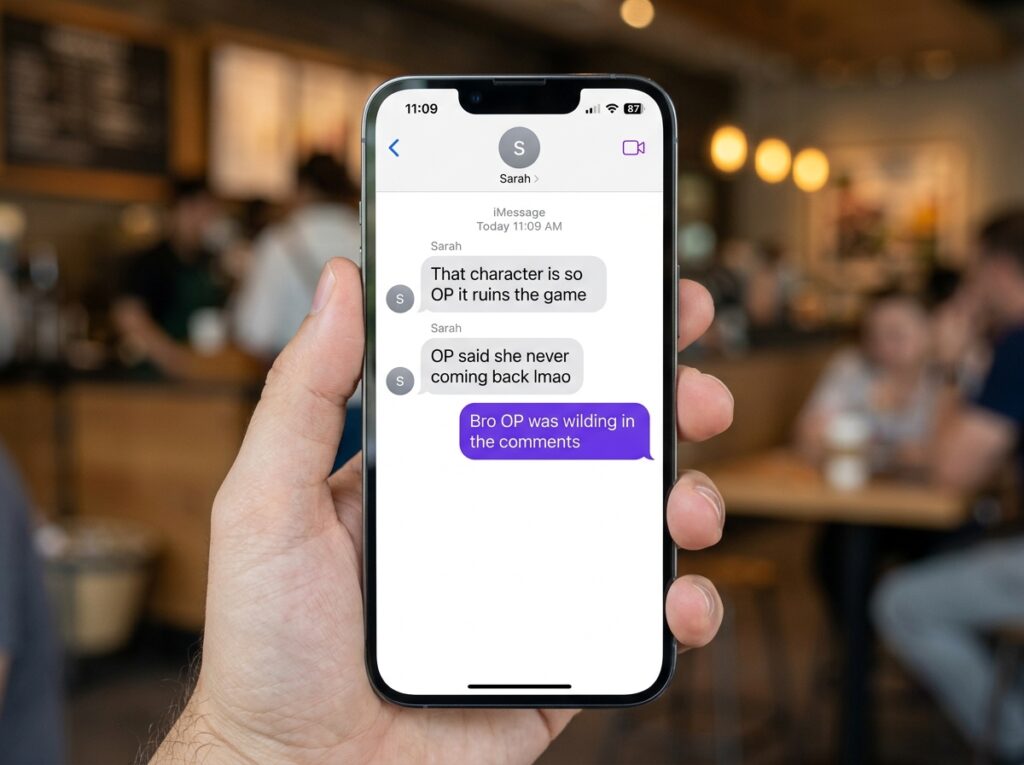
QUICK ANSWER: OP has two main meanings. First, “Original Poster” — the person who started a thread or post. Second, “Overpowered” — something that’s way too strong or dominant. Which meaning applies depends entirely on context.
When you see OP on Reddit, Twitter, or in comment sections, it almost always means Original Poster. This refers to whoever created the post everyone’s replying to. If someone says “OP is hilarious,” they’re talking about the person who wrote the original content.
In gaming circles, OP flips to mean Overpowered. A weapon, character, or strategy that’s unfairly strong gets called OP. “That new champion is OP” means it dominates and probably needs balancing.
The tone shifts with the meaning. Original Poster is neutral — just identifying someone. Overpowered carries frustration or admiration. You might complain a boss fight is OP. Or you might brag that your build is OP.
Here’s how context shapes it:
On a Reddit thread about cooking: “OP, what temperature did you use?” — talking to the person who posted.
In a Fortnite lobby: “Shotguns are OP this season” — complaining about weapon balance.
The two letters look identical. The situations tell you everything.
[DEFINITION GRAPHIC HERE — term on left, arrow, plain definition on right, white card background]
Origin and History of “OP”
OP as “Original Poster” traces back to early internet forums. Bulletin board systems in the 1990s needed a way to reference whoever started a thread. Typing out “the person who made this post” got old fast. OP solved that problem.
By the 2000s, forums like Something Awful and 4chan made OP standard vocabulary. Reddit later adopted it completely. Now it’s baked into how people discuss anything online.
The gaming meaning came later. “Overpowered” existed as gaming jargon before OP shortened it. Fighting game and MOBA communities started abbreviating it in the late 2000s. League of Legends and World of Warcraft players spread it further.
Both meanings exploded in the 2010s as internet culture went mainstream. Today, most people under 30 understand at least one meaning of OP. Many know both.
The split happened naturally. Forum users needed a word for posters. Gamers needed a word for broken mechanics. OP fit both needs perfectly.
How “OP” Is Used on Different Platforms
This is OP’s home turf for the “Original Poster” meaning. Every thread has an OP. Comments reference the OP constantly. “OP forgot to mention…” or “Did OP ever update us?” You’ll see it dozens of times in any popular thread.
Example: “OP, you need to leave that relationship immediately.”
TikTok
Both meanings appear here. Comment sections use Original Poster when discussing the video creator. Gaming content uses Overpowered when reviewing weapons or characters. Context usually makes it obvious.
Example: “OP really thought we wouldn’t notice that edit 💀”
Twitter/X
Original Poster dominates in quote tweets and threads. When someone quote-tweets with “OP is actually correct here,” they mean the original tweeter. Gaming Twitter uses the Overpowered meaning in discussions.
Example: “OP cooked with this take ngl”
Discord/Gaming Chats
Overpowered rules here. Players constantly debate what’s OP in their current game. Balance discussions, tier lists, and patch notes all revolve around this word. It’s as common as NPC meaning when roasting boring behavior.
Example: “Nerf this OP character already, I’m tired of losing to it.”
Snapchat
Less common overall. When it appears, it’s usually the Overpowered meaning in gaming group chats. Original Poster doesn’t fit Snapchat’s format since stories don’t have comment threads.
Example: “bro that combo u showed me is OP fr”
| Platform | Common Use | Tone | Example |
|---|---|---|---|
| Original Poster | Neutral/Direct | “OP please update us” | |
| TikTok | Both meanings | Varies | “OP ate with this one” |
| Twitter/X | Original Poster | Conversational | “OP understood the assignment” |
| Discord | Overpowered | Frustrated/Excited | “That ability is OP” |
| Gaming chats | Overpowered | Competitive | “OP build, gonna use it” |
OP in Texting vs. Real Life
In texts, OP flows naturally. You might text a friend “OP in that thread is so wrong” or “this loadout is OP.” Both meanings work fine in casual typing.
Speaking OP out loud is less common but still happens. Gamers say it constantly on voice chat. “That’s so OP, dude” sounds normal in a gaming context.
Saying “OP” to mean Original Poster in conversation sounds a bit awkward. You’d probably just say “the person who posted” instead. The abbreviation works better in writing.
The gaming meaning translates to speech more smoothly. “Overpowered” is already a spoken word, so shortening it feels natural. You’ll hear it on gaming streams, YouTube videos, and in any room where people play together.
Examples of “OP” in Sentences
GROUP 1 — Friendly/Casual
“OP asked a really good question in that thread.”
“Wait, is OP the same person who posted last week?”
“Someone tell OP they’re overthinking this.”
GROUP 2 — Gaming/Competitive
“This new rifle is OP, they need to patch it.”
“Your strategy was so OP we won in like five minutes.”
GROUP 3 — Sarcastic/Humorous
“OP really said that with their whole chest 😭”
“My ability to procrastinate is honestly OP.”
GROUP 4 — Online/Caption Use
“OP delivered with this meme.”
“When OP comes back to update the story >> “
“Not OP thinking nobody would notice the photoshop.”
[EXAMPLE CHAT SCREENSHOT MOCKUP — fake phone chat bubbles, iMessage or WhatsApp style]
Variations and Related Slang
You might see OP written differently depending on the situation. Some people type “op” in lowercase. Others capitalize both letters as “OP.” A few spell it out as “O.P.” with periods. All mean the same thing.
Related gaming terms include nerf (to weaken something OP) and buff (to make something stronger). Meta describes the current most effective strategies. Broken is another word for overpowered things.
For the forum meaning, related terms include ITT (in this thread) and TL;DR (summary of a long post). People often use IMO meaning when disagreeing with an OP’s take.
| Term | Meaning | Similar/Different? |
|---|---|---|
| OP | Original Poster / Overpowered | — |
| Nerf | Make something weaker | Opposite of OP (gaming) |
| Broken | Too strong, unfair | Synonym for OP (gaming) |
| ITT | In this thread | Related to OP (forum) |
| Meta | Most effective strategy | Often involves OP things |
Is “OP” Safe for Kids?
Yes, OP is completely safe. Neither meaning contains anything inappropriate.
Original Poster is just a neutral label. It’s like saying “the author” or “the creator.” No hidden meaning, no negative connotation.
Overpowered is gaming jargon for “too strong.” Kids use it constantly to describe characters, weapons, and strategies. It’s no different from saying something is “unfair” or “unbalanced.”
Parents won’t find anything concerning here. Teachers wouldn’t flag this term. It appears in game reviews, Reddit discussions, and casual gaming chats without any adult content attached.
The only thing worth knowing: if your kid says something is “OP,” they might be complaining about a video game balance issue. Or they’re impressed by something’s power. Either way, it’s harmless.
[PARENT SAFETY ICON — shield/safety graphic, 300x200px, “Parent Guide” label]
When to Use (and Avoid) “OP”
USE IT WHEN:
- Referring to whoever started a Reddit thread or social media post
- Describing an unbalanced game mechanic that’s too strong
- Complimenting something’s incredible effectiveness
- Chatting with people who understand internet/gaming culture
AVOID IT WHEN:
- Speaking to older adults who might not know the term
- Writing professional or formal documents
- The context could confuse which meaning you intend
- You’re in a setting where slang feels out of place
Conclusion
OP packs two completely different meanings into two letters. On forums and social media, it identifies the Original Poster. In gaming, it describes something Overpowered. Context tells you which one applies every time.
Understanding slang like OP connects you to how people actually communicate online. These shortcuts create shared language across platforms. They make conversations faster and communities tighter.
Next time you see OP in a comment, you’ll know exactly what’s happening. Whether someone’s tagging the thread creator or complaining about broken game mechanics, you’re in on it now. If you want to explore more gaming and internet slang, check out what based means — another term you’ll see constantly online.
FAQ
What does OP mean on Reddit?
On Reddit, OP stands for Original Poster. It refers to the person who created the thread or post that everyone is commenting on. When someone says “OP is right,” they’re talking about whoever started the discussion.
Is OP an insult?
No, OP is not an insult. Original Poster is neutral — it just identifies someone. Overpowered can carry frustration, but it’s directed at game mechanics, not people. Neither meaning is inherently negative or offensive.
What does OP mean in gaming?
In gaming, OP means Overpowered. It describes weapons, characters, abilities, or strategies that are too strong compared to everything else. Gamers use it when something feels unfair or needs to be balanced by developers.
Can OP mean both things at once?
No, each use of OP means one thing or the other. Context makes it clear. Forum discussions use Original Poster. Gaming conversations use Overpowered. You won’t confuse them once you know both meanings.
Why do people call someone OP instead of their username?
Saying OP is faster and works even when you forget the username. It’s universal across threads. Everyone knows OP means the original creator. It became standard on forums and stuck because it’s efficient and clear.