You’re scrolling through TikTok. Someone’s doing insane tricks with a spinning thing on a string. The caption says “diabolo life.” Wait—is that a devil reference? Or some weird slang you missed?
Here’s the confusion. Diabolo sounds exactly like “diablo,” which means devil in Spanish. Your brain connects the dots wrong. But this word has nothing to do with Satan, demons, or anything dark.
Diabolo is actually a juggling prop. It’s been around for centuries. And right now, it’s having a serious moment online.
Skill toy videos are everywhere in 2026. Diabolo tricks sit right next to yo-yo tutorials and kendama clips. The word keeps popping up in comments, captions, and gaming usernames.
If you’ve seen this word and felt confused, you’re not alone. The spelling throws people off constantly. Some folks mix it up with what sigma means because both words sound vaguely foreign and mysterious.
The good news? This one’s easy to understand once you know what you’re looking at.
What Does Diabolo Mean?
QUICK ANSWER: A diabolo is a juggling toy shaped like an hourglass or two cones connected at the points. You spin it on a string attached to two sticks you hold in your hands. The name comes from Greek, meaning “to throw across.”
The diabolo is part of a category called skill toys. Think yo-yos, kendamas, and spinning tops. It takes practice and coordination.
When someone says “diabolo” online, they usually mean one of three things. First, the physical toy itself. Second, the skill or hobby of using one. Third, their username or online identity built around the hobby.
The tone is almost always positive and enthusiastic. Diabolo communities are welcoming. People share trick tutorials and celebrate progress videos. There’s no edge or sarcasm to this word.
You might see someone comment “that diabolo combo was insane” on a performance video. Or a bio that reads “diabolo player | 5 years.” The context is always about skill, practice, and the toy itself.
Unlike slang that changes meaning based on who says it, diabolo stays consistent. Whether a pro performer or a beginner uses the word, it means the same thing.
Origin and History of “Diabolo”
The diabolo started in ancient China. Early versions were called “kouen-gen,” meaning “make the hollow bamboo stick hum.” These toys made a whistling sound when spun fast.
Traders brought the toy to Europe in the late 1700s. It became wildly popular in France and England. The French gave it the name “diabolo” from the Greek word “diaballein.” This meant “to throw across” or “to toss.”
Here’s where the confusion started. “Diabolos” also shares roots with the word “devil” in some languages. But the toy’s name specifically comes from the throwing meaning—not the evil one.
The toy had boom-and-bust cycles of popularity. It was huge in the early 1900s. Then it faded. Modern materials brought it back in the 1980s. Rubber diabolos replaced wooden ones.
Now in 2026, social media has given diabolo its biggest platform ever. Trick videos regularly hit millions of views. The word appears constantly in skill toy spaces online.
How “Diabolo” Is Used on Different Platforms
TikTok
This is diabolo’s biggest home right now. Performance videos dominate. Creators post trick tutorials, combo challenges, and mesmerizing slow-motion clips. “Learning diabolo day 30” style content performs well.
Example: “Finally landed my first around the leg! 🎯 #diabolo #skilltoy”
Instagram leans toward polished content. Diabolists post edited performance reels and aesthetic shots of their gear. Captions tend to be shorter and hashtag-heavy.
Example: “Golden hour diabolo session ✨ #diabololife”
YouTube
Long-form tutorials live here. Full performance videos and competition footage get uploaded. Comments discuss technique in detail. The community tone is supportive and educational.
Example: “How I learned the genocide combo in 6 months”
Discord/Gaming Chats
Diabolo appears in usernames frequently. Gaming communities have players named “DiaboloKing” or “DiaboloDan.” It signals the hobby as part of their identity. Sometimes people react with SMH when tricks fail hilariously.
Example: “DiaboloMaster42 just clutched that round lol”
The r/diabolo subreddit is active. Users share progress videos, ask for trick advice, and review equipment. Discussions stay friendly and beginner-welcoming.
Example: “Finally got a consistent high toss after 3 months!”
| Platform | Common Use | Tone | Example |
|---|---|---|---|
| TikTok | Trick videos, tutorials | Energetic, encouraging | “Day 50 of diabolo! Watch this combo 🔥” |
| Performance reels, gear photos | Aesthetic, proud | “New diabolo just dropped 🎯” | |
| YouTube | Full tutorials, competitions | Educational, detailed | “Complete beginner’s guide to diabolo” |
| Discord | Usernames, chat mentions | Casual, identity-based | “Nice clip DiaboloQueen!” |
| Progress posts, Q&A | Supportive, technical | “Need help with my elevator trick” |
Diabolo in Texting vs. Real Life
People say “diabolo” out loud all the time. It doesn’t sound weird spoken. The pronunciation is “dee-AH-bo-lo” with four syllables.
In texting, you’ll see it in casual hobby discussions. “Wanna diabolo later?” means “want to practice together?” It works as both a noun and a verb.
Real life conversations happen in parks, gyms, and meetups. Diabolo communities organize in-person sessions regularly. The word sounds natural in any context about the hobby.
There’s no meaning shift between typed and spoken. Unlike slang that feels cringe out loud, diabolo works everywhere. Parents, teachers, and performers all use the same word the same way.
Examples of “Diabolo” in Sentences
GROUP 1 — Friendly/Casual
“I finally ordered my first diabolo yesterday!”
“Want to hit the park for some diabolo practice this weekend?”
“My diabolo string snapped mid-trick and I’m so bummed.”
GROUP 2 — Enthusiast/Proud
“Been doing diabolo for two years now and I still learn new things.”
“That diabolo performance at the festival blew my mind.”
GROUP 3 — Humorous/Self-Deprecating
“Tried to show off my diabolo skills and immediately dropped it on my foot.”
“My diabolo said goodbye to my face today. Send ice.”
GROUP 4 — Online/Caption Use
“POV: you discover diabolo at 25 and it becomes your whole personality 😅”
“Diabolo content incoming, sorry not sorry 🎯”
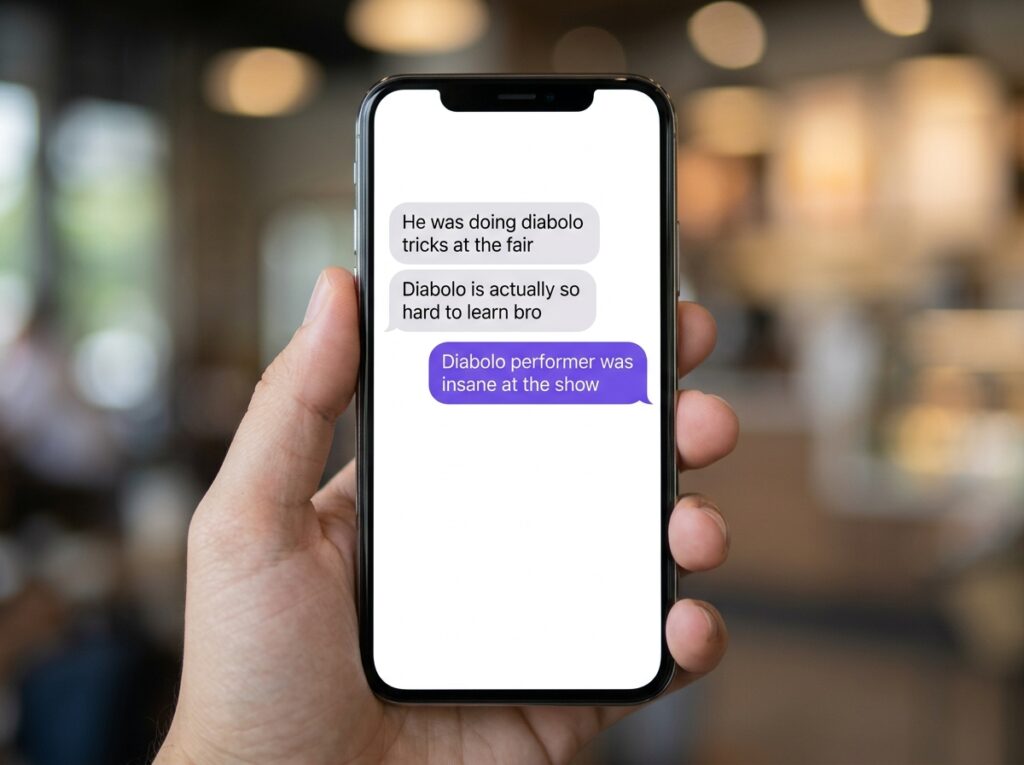
[EXAMPLE CHAT SCREENSHOT MOCKUP — fake phone chat bubbles, iMessage or WhatsApp style]
Variations and Related Slang
The main spelling is “diabolo.” You’ll sometimes see “diablo” used incorrectly. This usually means the person confused it with the Spanish word for devil or the video game.
Some people write “d-olo” or “bolo” as shorthand in niche communities. But these are rare.
Related skill toy terms often appear alongside diabolo content. If you see POV captions on trick videos, diabolo might be featured.
Here are connected terms you’ll encounter:
Kendama — A Japanese cup-and-ball toy requiring precision and timing.
Flowarts — The umbrella term for movement-based performance props like poi and staffs.
Prop manipulation — Any skilled handling of objects for performance or hobby.
Juggling — The broader category diabolo falls under.
| Term | Meaning | Similar/Different? |
|---|---|---|
| Diabolo | Hourglass-shaped spinning toy on string | — |
| Kendama | Japanese ball-and-cup skill toy | Different prop, similar skill community |
| Flowarts | Performance movement with props | Broader category including diabolo |
| Yo-yo | String-attached spinning disc toy | Similar difficulty, different mechanics |
| Poi | Weighted balls on strings for spinning | Different style, same flowarts family |
Is “Diabolo” Safe for Kids?
Yes, diabolo is completely safe for kids. The word has no inappropriate meanings. It’s just a toy name.
The only confusion comes from the spelling similarity to “diablo” (devil). But context makes this clear fast. Anyone searching diabolo will find toy content, not anything dark.
Kids actually make up a huge part of the diabolo community. Many start around age 8-10. Schools sometimes include it in circus arts or PE programs.
Parents might see the word in their child’s search history or social media feeds. No alarm needed. This is healthy hobby content about coordination and physical skill.
Teachers wouldn’t flag this word. Diabolo clubs exist in middle schools and high schools. It’s considered a positive extracurricular activity.
The online community around diabolo stays remarkably wholesome. Trick tutorials, progress videos, and encouraging comments dominate. Toxicity is rare in this space.
[PARENT SAFETY ICON — shield/safety graphic, 300x200px, “Parent Guide” label]
When to Use (and Avoid) “Diabolo”
USE IT WHEN:
- Discussing the actual juggling toy or hobby
- Commenting on skill toy content online
- Searching for tutorials or equipment
- Connecting with other diabolo enthusiasts
AVOID IT WHEN:
- You mean “diablo” (devil in Spanish) or the video game
- You’re trying to sound edgy—this word won’t help
- Writing formal academic papers where “Chinese yo-yo” might be clearer
- Speaking to someone unfamiliar who might hear “devil”
Conclusion
Diabolo means a spinning juggling toy on a string—nothing more mysterious than that. The word comes from Greek roots meaning “to throw across.”
Understanding niche hobby terms helps you navigate online spaces better. Whether you’re watching trick videos or your kid mentions a new interest, knowing the word removes confusion.
Skill toy culture keeps growing. Diabolo sits alongside other zesty trending topics that pop up across social media feeds. Maybe you’ll even try spinning one yourself.
FAQ
What does diabolo mean in slang?
Diabolo isn’t really slang. It’s the actual name of a juggling toy shaped like an hourglass that spins on a string between two hand sticks. Online, people use it to discuss the hobby, share tricks, or identify as practitioners of the skill.
Is diabolo related to the devil?
No. Despite sounding like “diablo” (Spanish for devil), diabolo comes from Greek meaning “to throw across.” The similar spelling causes confusion, but the toy has zero connection to anything demonic or dark.
How do you pronounce diabolo?
Say it as “dee-AH-bo-lo” with four syllables. Emphasis goes on the second syllable. It rhymes with “see Pablo go.” Don’t pronounce it like “diablo”—that’s a different word entirely.
Is diabolo hard to learn?
Basic diabolo tricks take a few hours to learn. Getting consistent takes weeks. Advanced combos can take months or years. It’s similar to yo-yo difficulty—easy to start, deep to master. Most people see progress quickly with daily practice.
Why is diabolo trending on TikTok?
Skill toy content performs well on TikTok because it’s visually satisfying and shareable. Diabolo tricks look impressive in short videos. The algorithm favors this content, and creators have built large followings around daily progress clips.