Your friend shares a TikTok of a soldier surprising his kid at school. Tears, hugging, dramatic music swelling in the background. You watch it and think, “Okay, this is sweet, but it’s also… a lot.”
Then someone comments: “Pure schmaltz.”
And you’re sitting there like… what does that even mean? Is it an insult? A compliment? Some kind of food?
You’ve probably seen “schmaltz” pop up in movie reviews, social media comments, or casual conversations about music. It describes something that’s emotionally over-the-top. Think sappy love songs, tear-jerker commercials, and greeting cards that make you cringe a little.
The word has a fascinating origin that connects to actual cooking fat. Yes, really. But today, it’s all about feelings — the big, gooey, almost-too-much kind.
Understanding schmaltz helps you describe that specific type of content that tugs at your heartstrings maybe a bit too hard. It’s similar to how people use SMH to express disbelief at something excessive.
Let’s break down exactly what schmaltz means and how to use it.
What Does Schmaltz Mean?
QUICK ANSWER: Schmaltz means excessive sentimentality or emotional content that feels overdone. It describes things that are sappy, corny, or dripping with forced emotion. Think cheesy love stories or overly dramatic music.
The word schmaltz (pronounced “shmahlts”) captures that specific flavor of emotional content that tries too hard. It’s not necessarily bad — some people love schmaltz. But it does imply that something crosses the line from genuine to gushy.
When someone calls a movie “pure schmaltz,” they mean it lays on the emotions thick. Violins playing. Someone crying in the rain. A slow-motion reunion hug. You get the picture.
The tone of schmaltz isn’t always negative. Sometimes people say it affectionately: “I know this song is total schmaltz, but I love it anyway.” Other times, it’s critical: “This commercial is just manipulative schmaltz.”
Context matters here. A romantic comedy fan might embrace schmaltz happily. A cynical film critic might use it as a takedown.
For example: “The ending was so schmaltz — they literally had a sunset proposal on a bridge.” Or: “My grandma loves schmaltz. She cries at every Hallmark movie.”
You can also call someone “schmaltzy” if they act overly sentimental. And honestly? Sometimes being a little schmaltzy feels good.
Origin and History of “Schmaltz”
Schmaltz comes from Yiddish, where it literally means “rendered animal fat.” Specifically, it usually refers to chicken fat used in traditional Jewish cooking. Picture your grandmother cooking with rich, golden fat — that’s schmaltz.
So how did cooking fat become a word for emotional overkill?
The connection is texture. Real schmaltz is thick, rich, and greasy. When something emotional is “schmaltzy,” it feels equally thick and over-rich. The metaphor works perfectly.
The word entered American English in the early 1900s. Jewish immigrants brought Yiddish expressions with them, and schmaltz stuck around. By the mid-20th century, it was common in entertainment criticism.
Hollywood reviewers started calling sappy movies “schmaltzy” in the 1930s and 1940s. The word described tearjerkers and melodramas that piled on emotion without subtlety.
Today, schmaltz lives everywhere. Music critics use it for ballads that feel forced. Social media users drop it on viral videos designed to make you cry. The word has moved far beyond its Yiddish cooking roots while keeping that same greasy, over-the-top feeling.
How “Schmaltz” Is Used on Different Platforms
TikTok
On TikTok, schmaltz shows up in comments on emotional content. Military reunions, pet adoption videos, and romantic proposals all get called out. Someone might comment: “This is schmaltz and I’m crying anyway.”
Creators sometimes lean into it deliberately. They’ll add dramatic music and slow motion, then caption it “giving you schmaltz” as a self-aware move.
Instagram captions and comments feature schmaltz when someone posts overly sentimental couple content. “Three years with my soulmate” posts with dramatic black-and-white photos? That’s schmaltz territory.
In DMs, friends might roast each other: “Your anniversary post was peak schmaltz lol.”
Twitter/X
Twitter users deploy schmaltz as media criticism. Movie discussions, TV show reactions, and music takes all use it. “The finale was beautiful but also total schmaltz, IMO.”
It’s also common during awards season when acceptance speeches get emotional.
Subreddits like r/movies and r/television use schmaltz frequently. “This director can’t help but add schmaltz to every third act.” Reddit leans analytical, so the word gets used critically more often.
Discord/Gaming
Less common here, but gamers might call a storyline or cutscene schmaltzy. “The ending cinematic was pure schmaltz.”
| Platform | Common Use | Tone | Example |
|---|---|---|---|
| TikTok | Commenting on emotional videos | Playful/affectionate | “Pure schmaltz but I’m sobbing” |
| Critiquing sappy couple posts | Teasing | “The schmaltz is strong here” | |
| Twitter/X | Film and TV criticism | Analytical | “Great acting, too much schmaltz” |
| Media discussion threads | Critical | “Spielberg loves his schmaltz” | |
| Discord | Game story reactions | Casual | “That ending was schmaltzy” |
Schmaltz in Texting vs. Real Life
People absolutely say “schmaltz” out loud. Unlike many internet slang terms, this one works perfectly in spoken conversation.
You might hear someone say it after leaving a movie theater: “That was so schmaltzy, but I still cried.” It sounds natural because the word has been in English for over a century.
In texts, schmaltz appears the same way. “This song is schmaltz” hits just as clearly as saying it face-to-face.
The meaning stays consistent between typed and spoken use. There’s no hidden layer or tonal shift. What does change is delivery — spoken schmaltz often comes with an eye roll or a knowing smile. In text, you might add an emoji to show you’re being playful rather than harsh.
Examples of “Schmaltz” in Sentences
GROUP 1 — Friendly/Casual
“I love holiday movies even though they’re total schmaltz.”
“My dad’s toast at the wedding was sweet but definitely had some schmaltz.”
“That commercial with the puppy and the kid? Peak schmaltz.”
GROUP 2 — Romantic/Flirty
“I know this is schmaltz, but you really are my favorite person.”
“Our song is pure schmaltz and I wouldn’t change it.”
GROUP 3 — Sarcastic/Humorous
“Oh great, another proposal video with the sunset. Bring on the schmaltz.”
“They really went for maximum schmaltz with that soundtrack choice.”
GROUP 4 — Online/Caption Use
“Yes this is schmaltz and no I don’t care 😭”
“Posting schmaltz because I miss my dog.”
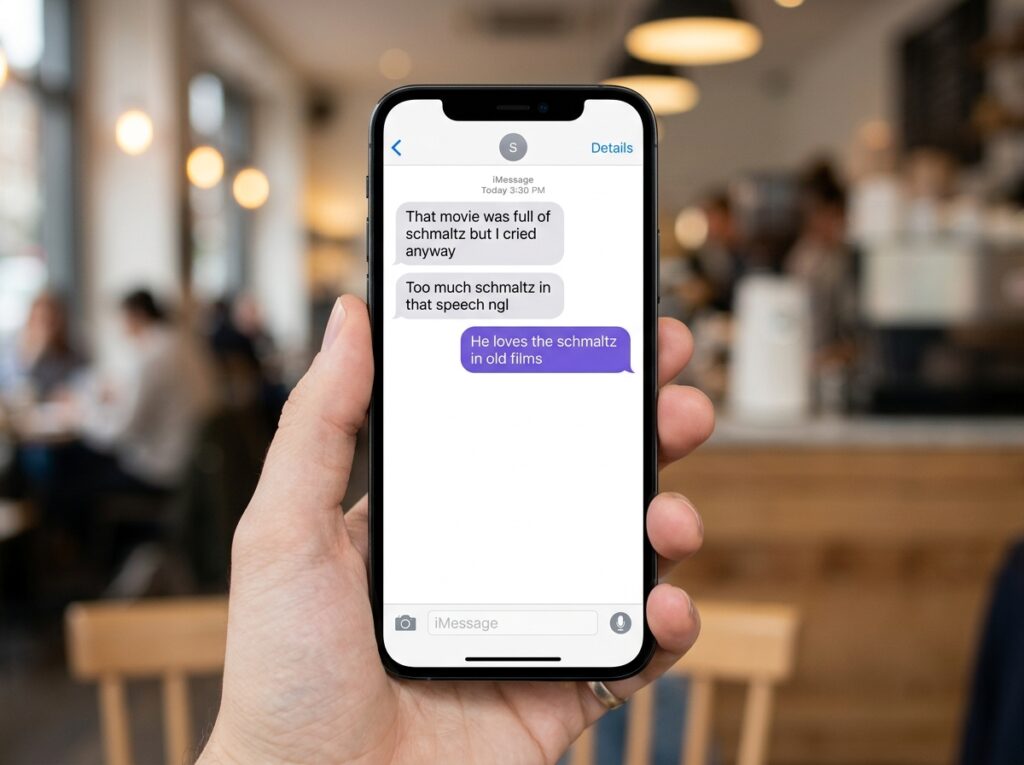
[EXAMPLE CHAT SCREENSHOT MOCKUP — fake phone chat bubbles, iMessage or WhatsApp style]
Variations and Related Slang
The main spelling is “schmaltz,” but you’ll also see “shmaltz” without the C. Both are correct. “Schmaltzy” is the adjective form.
Some people write “schmalz” dropping the T entirely. This closer to German spelling, but it’s less common in American English.
Related slang captures similar vibes. If you know what poignant means, schmaltz is like poignant turned up to eleven — where the emotion becomes almost excessive.
Here are similar terms worth knowing:
Cheesy — corny or overdone, often with less emotional weight than schmaltzy.
Sappy — overly sweet and sentimental, very close to schmaltz.
Corny — predictable and cliché, but not always emotional.
Melodramatic — exaggerated emotion in behavior or storytelling.
Kitschy — tacky in a charming way, more about aesthetics than feelings.
| Term | Meaning | Similar/Different? |
|---|---|---|
| Schmaltz | Excessive sentimentality | — |
| Sappy | Overly sweet emotion | Very similar |
| Cheesy | Corny or overdone | Similar but broader |
| Melodramatic | Exaggerated emotional behavior | More about actions |
| Kitschy | Charmingly tacky | Different — visual focus |
Is “Schmaltz” Safe for Kids?
Yes, schmaltz is completely safe for kids. There’s nothing inappropriate about the word itself.
It simply describes something overly emotional or sappy. A child calling a movie “schmaltzy” is just giving their honest opinion about the emotional tone.
The word has no offensive origins or hidden meanings. It comes from Yiddish cooking terminology and evolved into everyday slang over decades.
Teachers wouldn’t flag this word. Parents don’t need to worry if their kids start using it.
If anything, it shows a kid has a solid vocabulary. Understanding that some content is emotionally manipulative — and having a word for it — is actually a useful skill.
The only minor consideration: make sure kids understand the difference between criticizing content and dismissing genuine emotions. Calling someone’s real feelings “schmaltz” could be hurtful. Context matters.
[PARENT SAFETY ICON — shield/safety graphic, 300x200px, “Parent Guide” label]
When to Use (and Avoid) “Schmaltz”
USE IT WHEN:
- Describing movies, shows, or music that feel emotionally overdone
- Teasing friends about their sappy social media posts
- Admitting you enjoy something cheesy without shame
- Writing reviews or critiques of media
AVOID IT WHEN:
- Someone is sharing genuine emotions with you
- The setting is formal or professional
- You’re talking to someone unfamiliar with the word
- Criticizing content that’s meaningful to someone right in front of you
Conclusion
Schmaltz means emotional content that’s laid on thick — sappy, gooey, and unapologetically over-the-top. It’s the slow-motion reunion hug. The dramatic piano music. The tear rolling down at exactly the right moment.
The word gives you language for that specific feeling when something tugs at your heartstrings a little too hard. And that’s valuable. Sometimes you want to embrace the schmaltz. Other times, you want to call it out.
Slang like this connects us to cultural history while staying useful today. Just like understanding what surreal means helps you describe strange experiences, knowing schmaltz helps you talk about emotional excess.
Next time something feels almost too sweet, you’ve got the perfect word ready.
FAQ
What does schmaltz mean in simple terms?
Schmaltz means something that’s overly emotional or sappy. It describes movies, songs, or moments that pile on feelings in a way that feels excessive or manipulative. The word can be used critically or affectionately.
Is schmaltz a negative word?
Not always. Some people use it critically to call out forced emotion. Others use it fondly to describe content they enjoy despite its sappiness. Tone and context determine whether it’s an insult or just an observation.
Where does the word schmaltz come from?
Schmaltz comes from Yiddish, where it originally meant rendered chicken fat used in cooking. The thick, rich texture of the fat became a metaphor for thick, rich emotion in entertainment and conversation.
Can I use schmaltz in formal writing?
It’s generally informal but widely understood. You might use it in a casual article or review, but it’s probably too casual for academic papers or professional reports. Know your audience.
What’s the difference between schmaltz and cheesy?
Schmaltz specifically targets emotional excess — things trying to make you cry or feel warm inside. Cheesy is broader and can describe anything corny or predictable, whether emotional or not.